

Slipping out of Palaceside Building for a wander. Walking the East Gardens of the Imperial Palace (Edo Castle) this season, greenery bursting — it really is wonderful.
Lately it has been 25–30 degrees, a little sweaty, but the wind is fresh.
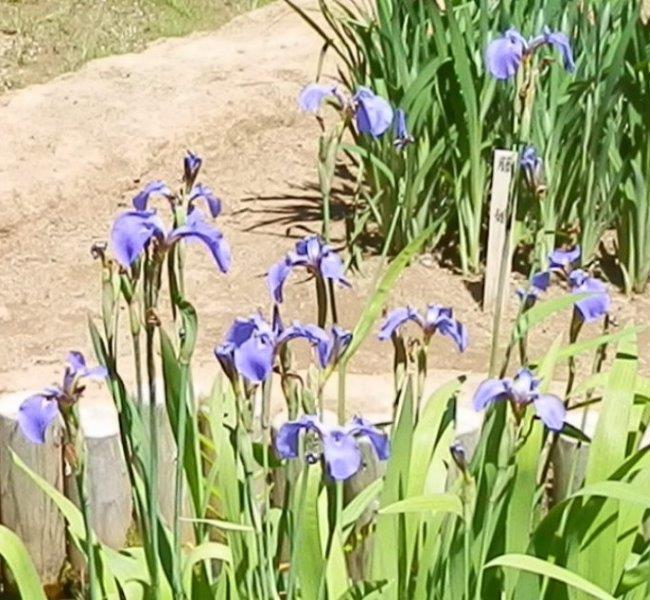
From Hirakawa Gate into the Ninomaru Garden, green stands out overall. The vivid red and pink azalea and satsuki season is over; the irises of the “Shobu-da” beds are still to come — a subtle moment, few flowers catch the eye. Among them, flowers clustered in front of the Ninomaru Pond wisteria trellis (wisteria already over) (photo above). What are they?
Ayame? Kakitsubata?
There was no sign, but someone nearby who seemed to know flowers said they were likely kakitsubata. A whitish blotch from the center outward looks the part.
And the only bloom in the “Shobu-da” was “Nasu Hiogi-ayame” (photo at lower right). An endangered plant found in 1962 in Nasu Town, Tochigi Prefecture; it came to be grown in the East Gardens through Emperor Showa, known from his book “Flora of Nasu” as a new variety.
Asked how they differ, I could not get a close enough look, so I do not really know. After all, it is “izure ayame ka kakitsubata.”
The source verse is: “In the fifth-month rains the makomo by the stream has lost its water; I fret over which is the ayame” (Taiheiki 21).
Minamoto no Yorimasa (1104–1180), a late-Heian warrior. He rose by cooperating with the Taira, then could not bear their tyranny, joined Prince Mochihito’s rising, was defeated and took his own life.
Yorimasa is said to have slain a nue — a monster — that haunted the court, and as a reward was to receive a beauty named Ayame-no-mae; told to pick her from twelve similar beauties, he could not tell them apart and composed the poem in distress.
But that poem only mentions ayame. Why did it come to be compared with kakitsubata? Later ages, finding ayame and kakitsubata so alike, made it “ayame or kakitsubata.”
By the way, “izure ayame” alone, following the anecdote, means “cannot tell one from many”; “izure ayame ka kakitsubata” means two things hard to rank — the usage differs a little.
Yet the ayame of Yorimasa’s time, some say, was not iris-family ayame, kakitsubata or hanashobu, but today’s arum-family shobu. Shobu is familiar as the leaves for Boys’ Festival baths; the flowers are inconspicuous yellowish-green, like Brussels sprouts. The Taiheiki is said to have been finished around the mid-14th century; someone, sometime, made this story? Well.
And hanashobu is commonly called shobu, so it all tangles. In the Manyo age arum-family shobu was ayame-gusa (pattern grass), and ayame, its leaves similar, was hana-ayame; from that remnant, it is generally said, hana-ayame became ayame and ayame-gusa became shobu. Even now shobu can be read shobu or ayame. Japanese is hard.