

This week has been relatively warm. The weekend is forecast to rise to around 20 degrees, then turn cold again next week. Please take care of your health.
Lured by the mild air, I left Palaceside Building for a walk in the East Gardens of the Imperial Palace and caught the scent of plum. The plums of Bairin-zaka, as you know. The season of plum-viewing crowds has come.
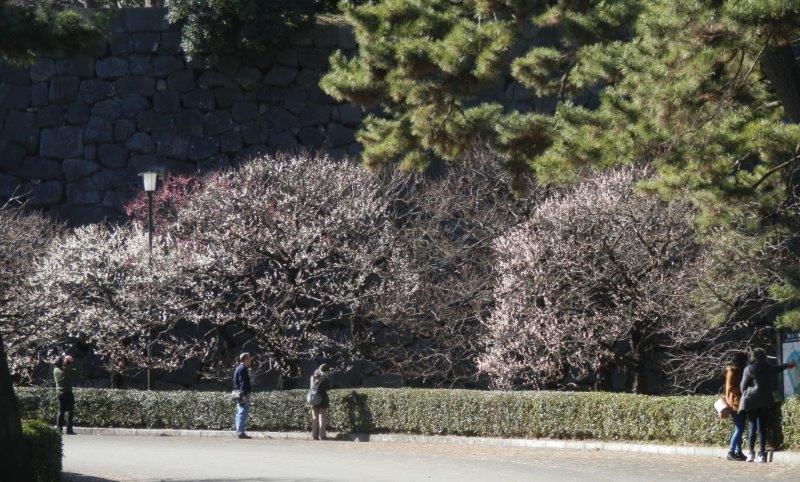
From Hirakawa Gate, near Takebashi Station and directly opposite Palaceside Building, a gentle slope leads up; soon a path turns right toward Kitahanebashi Gate and the tenshu-dai. That is Bairin-zaka. The photo at right is the foot of the slope.
In 1478 (Bunmei 10), before Tokugawa Ieyasu entered Edo, Ota Dokan, who built Edo Castle, is said to have enshrined Sugawara no Michizane and planted several hundred plum trees.
The present plums are white trees planted in 1968 (Showa 43) when the East Gardens opened, later joined by red; there are about 50.
There are many kinds, most with name tags, so walking while checking them is a pleasure.
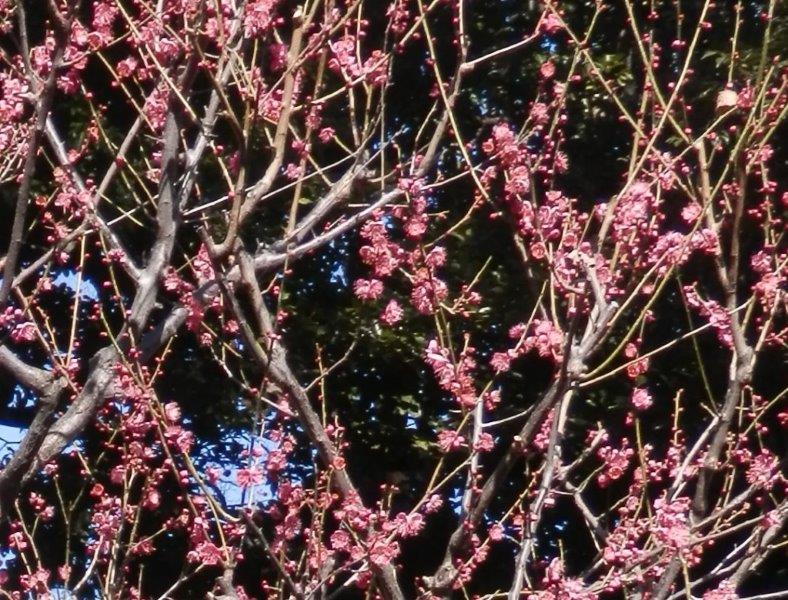
The photo at the very top is “Yae-kanko.” Plums of the rose family, genus Prunus, are native to China and came to Japan in antiquity. Yae-kanko is one cultivar; the characters look like a plum among plums, and I like it. Atami City presents early-blooming plums from Atami Baien each year on the Emperor’s birthday (December 23); they are said to be this “Yae-kanko” and “Toji-bai” — early bloomers.
Next is “Osakazuki” (photo at upper left), true to its name, with flowers a size larger than Yae-kanko. The red also seemed deeper.
Among white plums, “Yae-
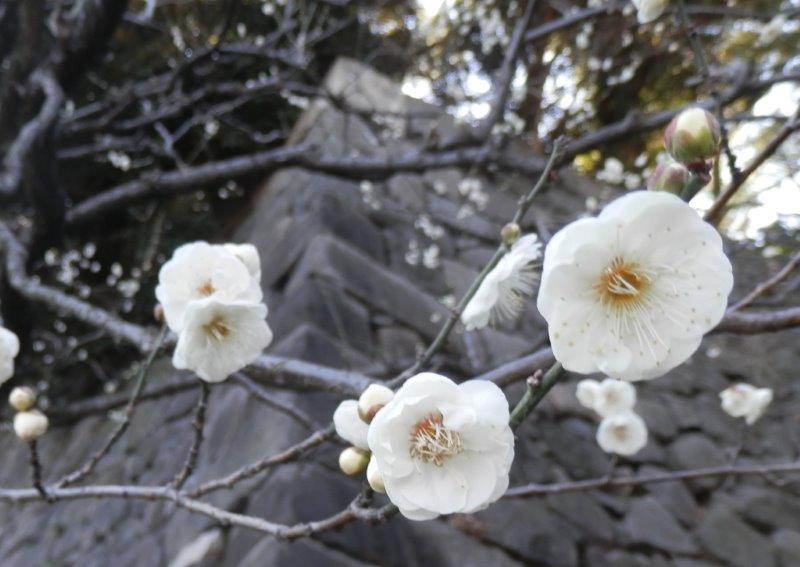
yabai” was in fine bloom (photo at middle left). Specks like sesame on the petals at right are stamens. As the name says it is double-flowered; it begins around mid-January and is a fragrant type.
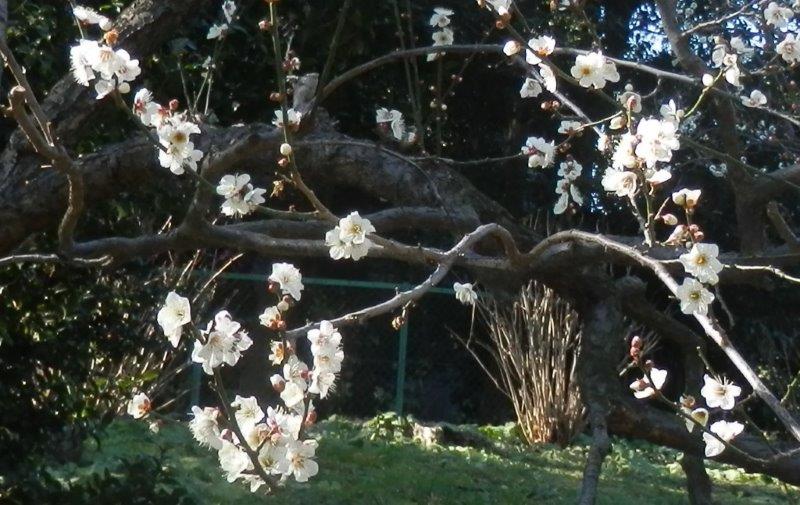
“Shin-toji” (photo at lower left) is, as the name says, an early bloomer from around the winter solstice, but when I went last week it was still beautiful.
According to the Imperial Household Agency site’s “East Gardens flower news,” bloom status is also posted for Shirokaga, Omoinomama, Kenkyo, Benichidori, Michishirube, Natsuka, En’o, Jako-
ume, Mikaiko and Tamabotan. So many kinds. The names surely each have meanings. I will look into that another time.