

Leaving Palaceside Building through Hirakawa-mon toward the East Gardens of the Imperial Palace, various flowers are beginning to bloom.
This time we introduce wintersweet (roubai).
The spot is a corner of the Ninomaru grove, west of the Ninomaru rest house. From Hirakawa-mon, down Ume-zaka toward the Naka-mon,
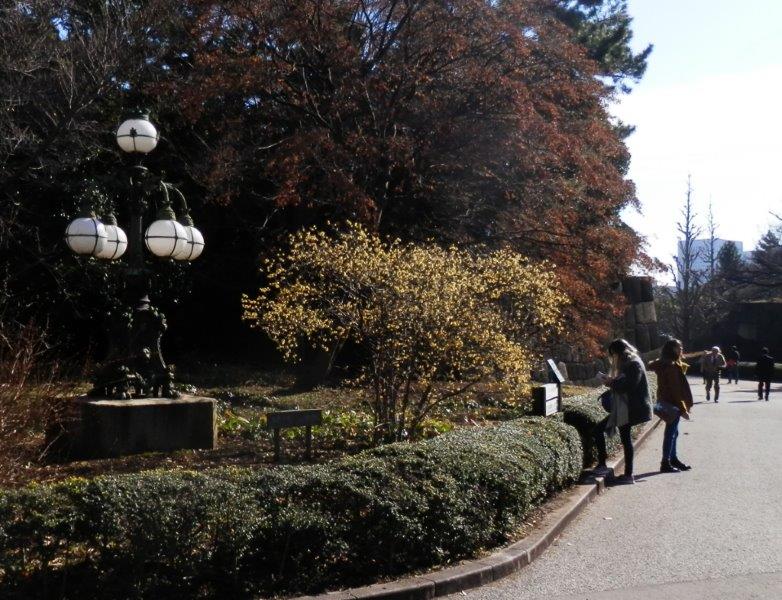
on the left, at the edge of the grove opposite Shiratori-bori, where the “Old Ornamental Lamp at the Main Gate Stone Bridge” stands = photo left.
Yellow is soshin wintersweet = photo above; whitish is wintersweet = photo lower right =. From afar it is not so harsh; close up may be a bit much. Warm through New Year brought a rush of bloom; wintersweet especially seems past its peak.
Wintersweet is written 蝋梅 in kanji. A deciduous shrub in the Calycanthaceae family, early types bloom around December, late ones around February. Semi-translucent flowers with a dull sheen and strong scent hang slightly downward. Color ranges from deep yellow to whitish; petal shapes vary round to narrow. Native to China, called “lamei” (臘梅); the name is said to come from petals like waxwork, or blooming in the twelfth lunar month (rougetsu), Japanized as roubai. It reached Japan in the Edo period and is also called karaue (唐梅) — “plum from Tang (China).”
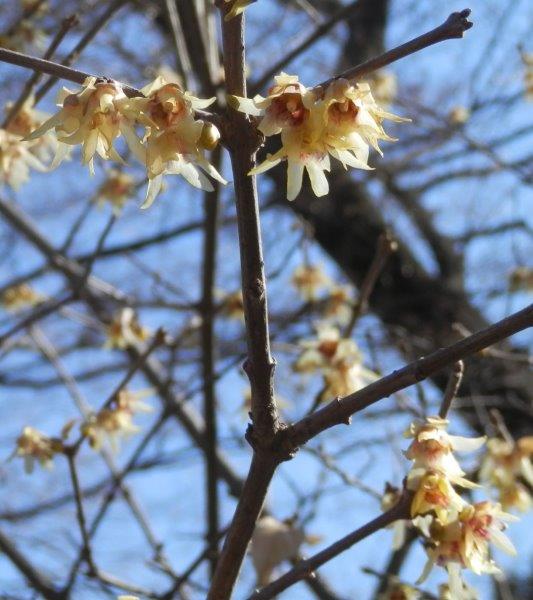
Not related to plum, though it resembles one — does it, really?????????????????????????
A seasonal word from late winter, around Shōkan (this year January 6) through the day before Risshun (Setsubun, this year February 3). For this season, it is quite a noticeable flower.
Soshin wintersweet is a garden cultivar. In wintersweet the inner petals are dark purple; in soshin the whole flower is clear yellow, petals round and scent strong — written 素心蝋梅. Online explanations vary: “soshin from a spongy white core in the stem,” “in China, flowers uniform in color from sepals to stamen are called soshin,” or “a cultivar where multicolor became single color.” Which is correct?