
Stepping out of Palaceside Building to explore Edo Castle (the Imperial Palace) across the way. We wrote on August 11 in this blog about the Shimizu family residence built inside Shimizu-mon as one of the Gosankyo. Together with the Tayasu and Hitotsubashi houses, the Gosankyo ranked below the Gosanke of Owari, Kii, and Mito in status, and their heads were promoted to Junior Third Rank and customarily appointed "kyo" (minister-level titles), which is why they came to be called Gosankyo.
The Gosankyo received 100,000 koku each from the shogunate, but although their domains were scattered across the country, they were governed by their own daikan offices rather than like ordinary daimyo with castles in their domains and sankin-kotai attendance. Retainers were mainly shogunal bannermen and others "seconded" from the shogunate — a special presence as kin of the shogunal house within Edo Castle.
Related to this, when a head died without an heir, unlike ordinary daimyo they were not simply abolished; an empty residence — an "ake-yashiki" — could remain, and this happened often.
It is said that the 8th shogun Yoshimune established the Tayasu and Hitotsubashi houses for his sons, and the 9th shogun Ieshige likewise established the Shimizu house for his son, because blood ties between the main Tokugawa line and the Gosanke had grown distant; placing other relatives near the shogunal family secured a pool of successors. The result was a tangle of adoptions back and forth among the main line, Gosanke, and others. Some also argue that bringing a new
powerful presence into intrigue-filled Edo Castle intensified political strife.
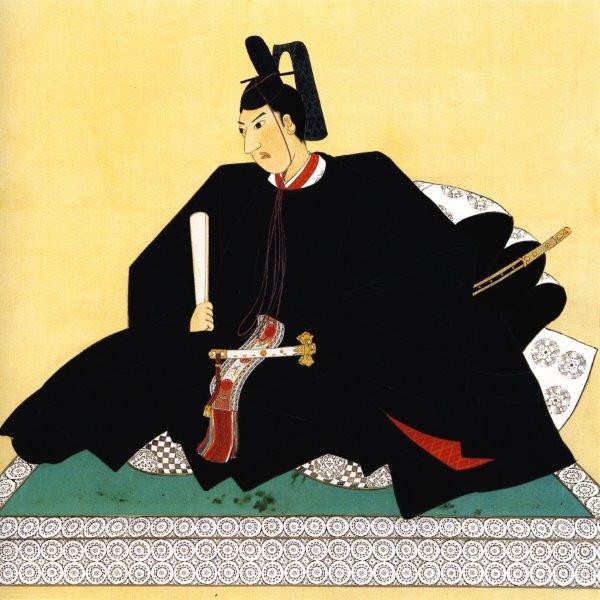
As for the Shimizu house: Iemochi, son of the 3rd head Nariyuki=portrait at right, became the 14th shogun, but Nariyuki had left Shimizu to succeed the Kii house before Iemochi was born, so no one became shogun directly from the Shimizu house.
From the first head Shigeyoshi, who had no biological heir, through the Meiji Restoration the house had no direct succession at all, repeatedly adopting from other Tokugawa branches while heads transferred to the Gosanke, leaving empty residences again and again — the most volatile of the Gosankyo.
The last Edo-period head was Akitake, the biological younger brother of the 15th shogun Yoshinobu=photo at top. At Yoshinobu's direction he led a government delegation to France for the Paris Exposition and stayed on to study (among the party was Eiichi Shibusawa, known as the father of Japanese capitalism). While abroad, the Restoration and Meiji government were established, and his elder brother Yoshinobu's brother Yoshinatsu, lord of Mito, died. Akitake returned in 1868 (Meiji 1), succeeded the Mito house, and Shimizu again became an empty residence. In 1871 Yoshinatsu's second son Atsumori became Shimizu head and joined the kazoku; under the 1884 Peerage Law he became a count. He returned his title in 1899, but his son Yoshitoshi, known as Japan's first aviator, later rose to lieutenant general and was made a baron again in 1928. Quite a turbulent lineage.