

Leave Palaceside Building and enter the East Gardens of the Imperial Palace through Hirakawa Gate across the street. Spring and summer splendor gone, it is a fine season to walk the Ninomaru Garden in full autumn mood.
Near the waterfall at Ninomaru Pond I noticed yellow farfugium flowers=photo above.
I had never really looked at them before — farfugium blooms.
Farfugium — we think of the leaves. Known as the crude drug “takugo,” my childhood memory is “good for pus.” In elementary school I often got “hyōsō” (small infections from finger wounds); when the skin between nail and finger swelled it hurt, and then my mother would wrap the fingertip in farfugium leaves and bandage it.
Native from Japan to Taiwan; south of southern Tōhoku on Honshu, Shikoku, Kyushu, Okinawa — an evergreen perennial flowering every year. Also widely seen in Taiwan, the Korean Peninsula, and China. Mainly on coastlines; height about 30–70 cm. Flowers are yellow heads about 5 cm across, dandelion-like.
Long-stalked glossy leaves resemble butterbur (fuki); one theory says “shiny fuki → tsuyabuki → tsuwabuki.” Another derives it from thick leaves: “atsuba fuki → atsubabuki.” Written in kanji as 石蕗.
Loved since old times, local names vary: “okabas,” “ishibuki,” “iwabuki,” “tsuwa,” “obako,” and in Okinawan “chiippappa.” Tsuwano (Shimane) is said to come from fields where farfugium grew wild — “ishibuki no no.”
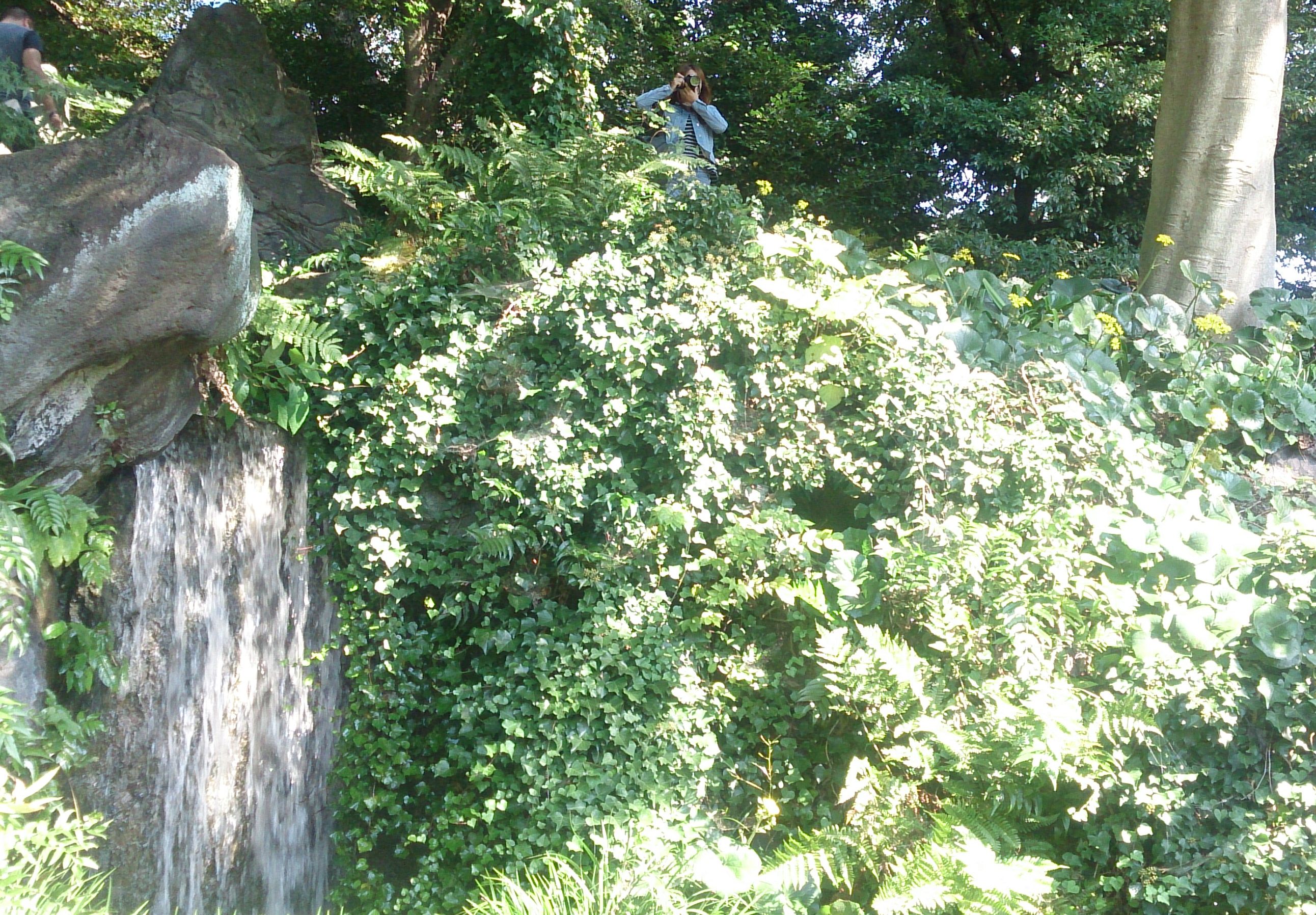
Beside the Ninomaru Garden waterfall (on the right as you face it), a small clump is planted=photo right. Blooms have just opened; they last through December — welcome color when few other flowers show.