

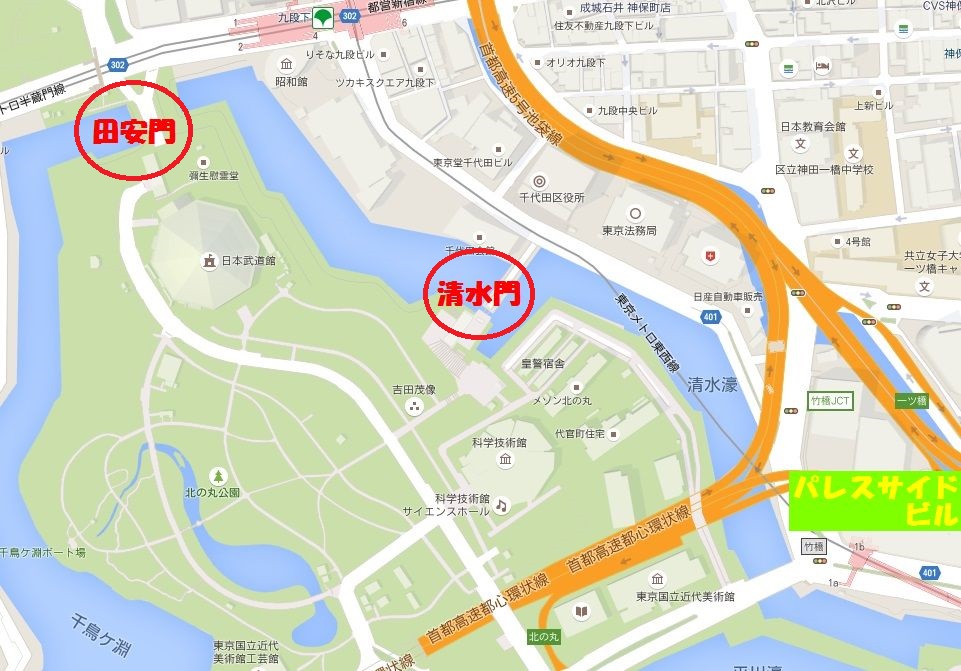
Leaving Palaceside Building for Shimizu-mon in front of Chiyoda Ward Office — when you hear this gate’s name, you must remember Kasuga-no-Tsubone.
In the early days when Ieyasu built Edo Castle, Kitanomaru was still bamboo groves, allotted to the residence of Naitō Kiyonari, Kantō daikan, and hatamoto houses — called Daikan-machi (today’s Metropolitan Expressway Daikan-machi section). As the castle was improved, it became residence land for Tokugawa kin. After the Great Meireki Fire (1657 = Meireki 3), mansions were cleared and it stayed largely open (a firebreak) until the end of the shogunate.
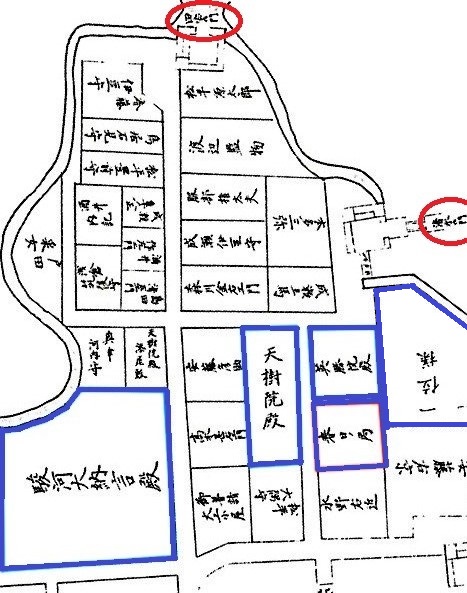
A pre–Meireki Fire map is on the website of Tsukudo Shrine (Kudankita 1, Chiyoda)=upper left. Besides □ Kasuga-no-Tsubone, the □ marks mansions of Eishō-in, Tenju-in, Ichii-sama, and Suruga-dainagon. Roughly today’s National Museum of Nature and Science and Imperial Guard barracks=see current map lower left.
Kasuga-no-Tsubone (1579–1643) wielded power in the Ōoku backed by her role as wet nurse to the third shogun Iemitsu.
Tsukudo Shrine devotes a page to her — because she was a parishioner of the shrine.
The shrine’s history was touched on in our February 2012 post on Taira no Masakado; here is a quick recap (from the shrine website).
In 940 (Tenkei 3), Masakado’s head, secretly taken from Kyoto, was enshrined at a Kannon hall near present Ōtemachi — the beginning of Tsukudohime-no-Mikoto
After the castle was built, in 1478 (Bunmei 10) Ōta Dōkan erected a shrine in the northwest (Inui) of Edo Castle as its guardian. In 1552 (Tenmon 21) it moved to Tayasu-go in Kamihirakawa (near present Kudanzaka and Mochinoki-zaka), took the place name and was called Tayasu Myōjin, counted among Edo’s three great shrines with Sannō (Hie) and Kanda. Ieyasu’s entry in 1589 (Tenshō 17) and expansion (ninomaru, etc.) forced a move to the Shimo-Tayasu rice-store site (near JR Iidabashi); in 1616 (Genna 2) the outer moat was widened and it moved to Tsukudo Hachiman-chō, Shinjuku, renamed Tsukudo Myōjin. In 1874 (Meiji 7), at parishioners’ request, Amaterasu’s grandson Ninigi-no-Mikoto was enshrined and the name became Tsukudo Shrine. Burned in air raids, April 1945 (Shōwa 20); rebuilt in Fujimi, Chiyoda, the next year; moved again in 1954 when Kudan Junior High (now Kudan Secondary) was built — to the present site.
The website’s “Kasuga-no-Tsubone” section quotes the Yōyō Zakki of 17 April 1634 (Kan’ei 11):
“Because Tsukudo is the ujigami of the castle (Kitanomaru), when Ōmidai-sama (Ieyasu’s lawful wife Go) was in good health, Kasuga-dono conveyed omamori from Tsukudo Shrine to the shogun’s family through her attendance.”
In other words, holding power firmly, the shrine too reached its peak.
Stories of Eishō-in and others — another day.