

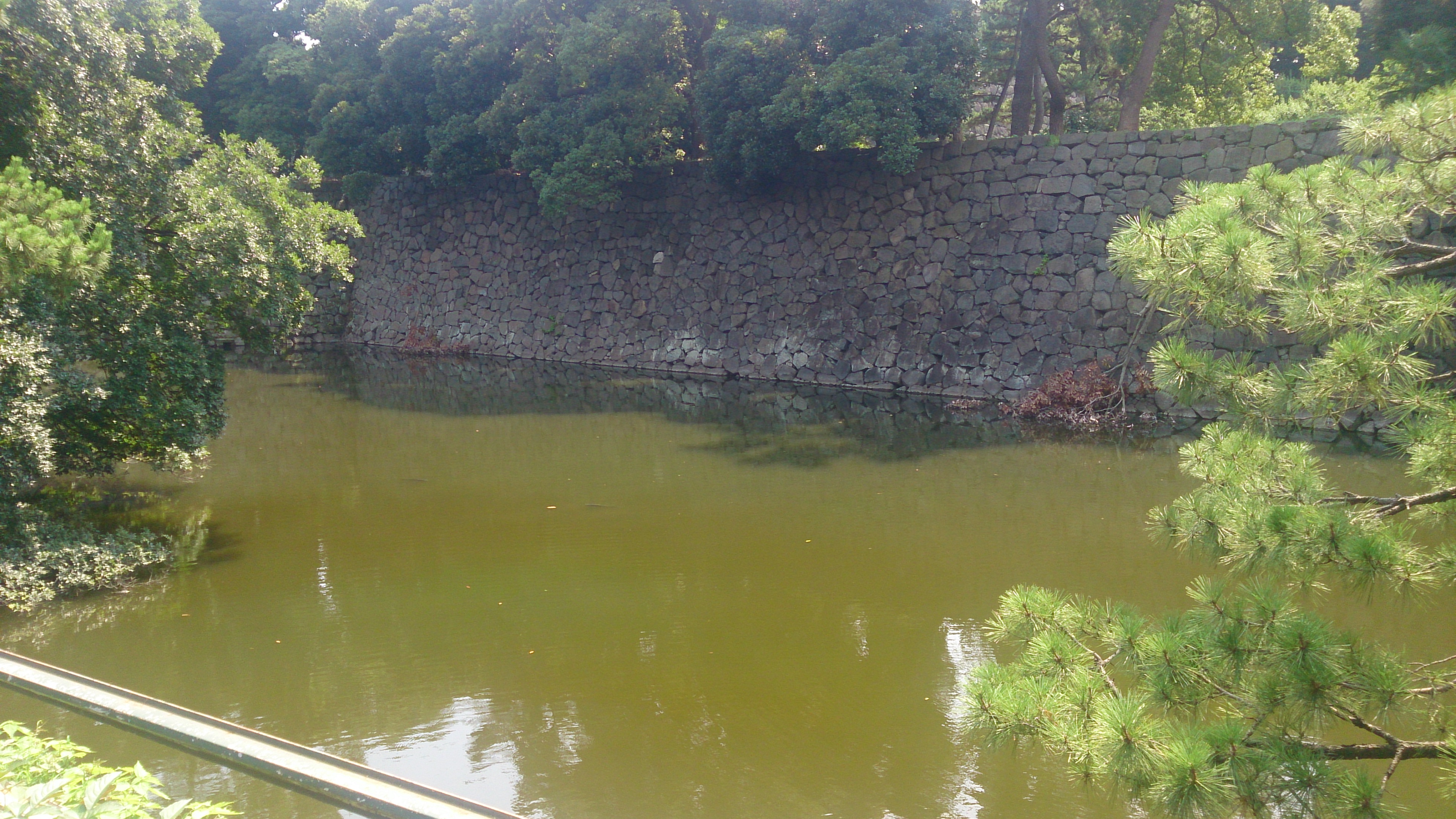
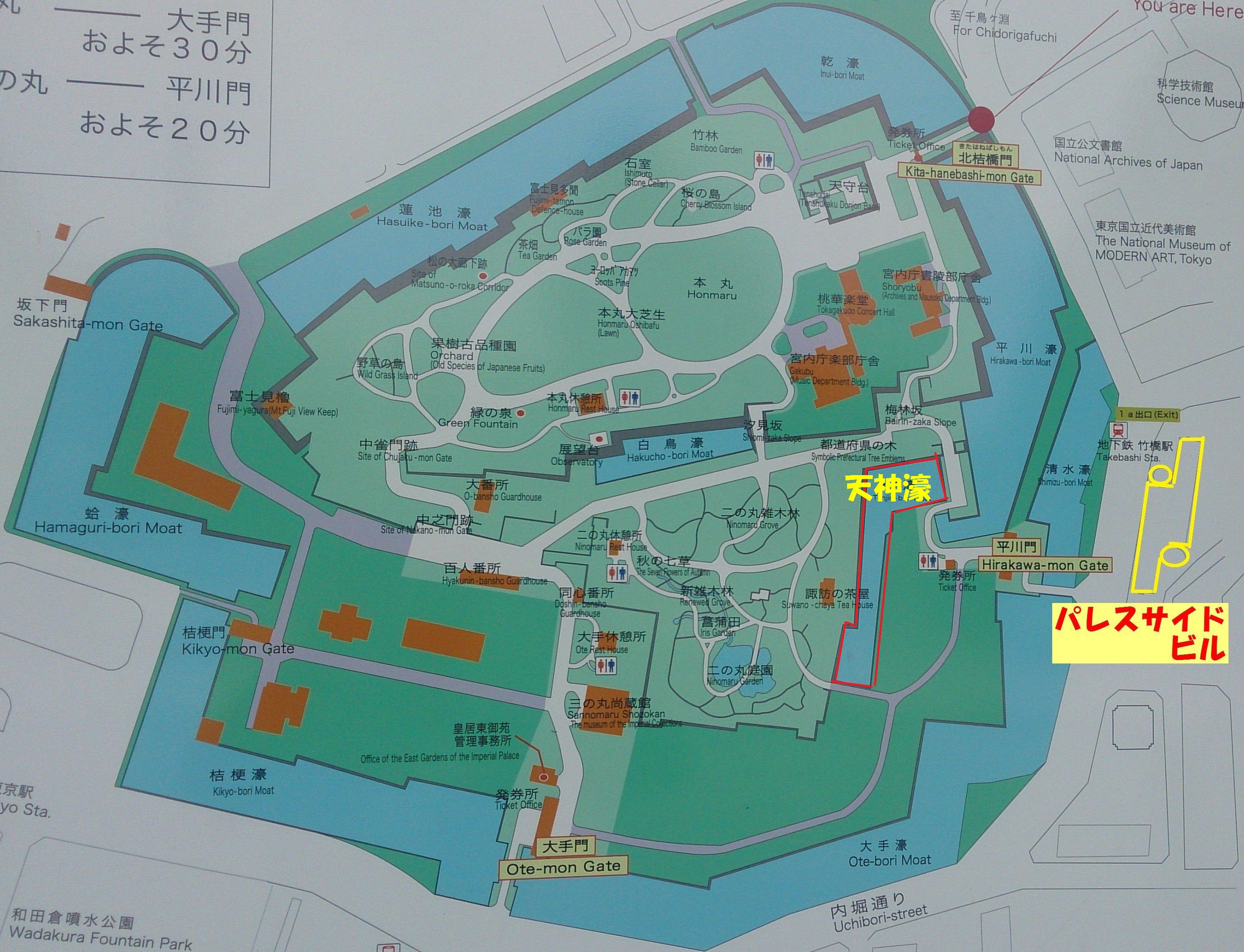
Directly across from Palaceside Building, on the way up toward Ninomaru Garden after entering Hirakawa Gate at Edo Castle (the Imperial Palace), you can see Tenjin-bori on the left. This year blue-green algae (aoko) seems to be rather bad here. Photo at top was taken on August 13 this year; photos at upper and lower right on July 15 last year. Quite a sight — shocking?!
Blue-green algae is what happens when tiny algae bloom massively on lakes and ponds where eutrophication has raised concentrations of fertilizer components such as nitrogen compounds, until they cover the surface. Tenjin-bori is exactly in that state.
Edo Castle’s moats are said to hold a total of 450,000 cubic meters of water across 12 locations, including Chidorigafuchi and Hibiya-bori near the Kasumigaseki government district
. Excluding Shiratori-bori, they are basically connected. Only a small part of Tenjin-bori is visible to the public, but it spreads fairly large on the north side of Ninomaru Garden and connects with Hirakawa-bori inside Hirakawa Gate = see map at upper left and lower left.
That said, unlike a river, water tends to stagnate, so conditions favor blue-green algae. Water used to enter from the Tamagawa-josui built in the Edo period, but supply stopped when the Yodobashi water treatment plant (Shinjuku) closed (1965); now the only outside water is rainwater. Conversely, heavy rain can also bring in overflow from sewers and worsen water quality.
Summer is especially tricky when temperatures are high and rain is scarce. This year Tokyo’s July averaged 26.2°C with 234 mm of rain — still better than last year’s 26.8°C and 105 mm — but August, as you know, brought day after day of heat; through the 13th when the top photo was taken, the average was 29.6°C, and recorded rainfall was only 1 mm on the 12th, though there were a few drizzly days. That is probably the direct cause of the bloom (a bit of rain over the weekend brought August 1–17 rainfall
to 45.5 mm total).
The Ministry of the Environment, which manages the moats, has been working on purification over the medium term. In fiscal 2009 it adopted the “Imperial Palace Outer Gardens Moat Management Policy and Water Quality Improvement Plan.” A new moat purification facility went online in fiscal 2013, and water quality seems to be improving overall.
This year is also the year to formulate a “new plan,” whose basic philosophy is the “Basic Goals of the Imperial Palace Outer Gardens Moat Management Policy” — showing how the nation intends to treat the moats. It aims quite high, so here are all four items.
・Maintain dignity combining solemnity, calm and quiet as an irreplaceable symbol of a peaceful, cultural nation, and as an important element of a national park with the special character of the Imperial Palace forecourt.
・Preserve and pass on a landscape that conveys the accumulation of history and culture from the early modern period to the present centered on Edo Castle, together with preservation of remains on the Edo Castle site.
・Maintain precious water and green in the city center and restore the Imperial Palace outer moats’ inherent capacity as habitat and breeding ground for living things and for the local environment.
・Welcome visitors from inside and outside while taking care not to impair the character of the outer gardens, and communicate the appeal of the moats appropriately.
Concretely, they are also studying possibilities such as drawing groundwater from Tokyo Metro, but there are issues too — “salt content is not a problem, but nitrogen concentration is high; there is concern about the impact of introducing water without a system to remove nitrogen” (Ministry of the Environment) — so it is no easy task.
Formulating this “new plan” also looks ahead to the 2020 Tokyo Olympics and Paralympics. Of course — many people from around the world will come to Tokyo. The ministry’s basic policy for the new plan states: “For immediate measures, given the expected increase in visitors from home and abroad with the Games, advance measures with roughly 2020 in view.”
So what kind of moats can we show visitors from around the world?