

“Palace Stroll” is back after a while (of course a knockoff of a famous veteran TV show). Walking Edo Castle (the Imperial Palace) is still “strolling around Palaceside,” after all…
Strolling around Edo Castle, various structures bring the Sengoku period, the Edo period and the Meiji Restoration to mind. But it is not only the “old” past. Remains tied to World War II also survive. The photo shows a structure like a round bench. The top is finished with decorative stone like a lid.
The place is up Kii-no-kuni-zaka from Palaceside Building toward Daikancho, a little past the Metropolitan Expressway entrance, on the right side of the road. Do not turn in toward Kitanomaru Park or the Crafts Gallery of the National Museum of Modern Art (the former Imperial Guard Division headquarters). Stay on the left, go straight along the road past the Crafts Gallery, cross as if over the expressway to the left, and ahead is a low, green earthen bank. It is a long east–west strip between the road (on the left) and Chidorigafuchi. Walk straight along the bank for about five minutes and you arrive (around the red circle on Google Earth). Even in hot summer the breeze in the shade is reasonably pleasant here.
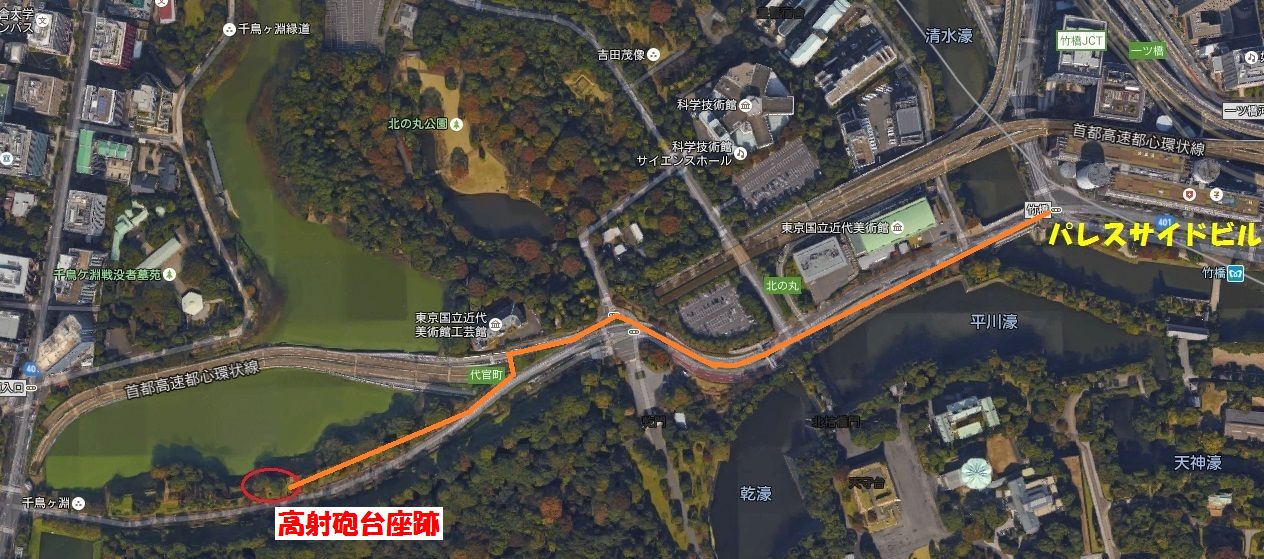
There are seven round concrete masses, each a little under two meters across. Not in a perfect line, but they stand in a row of sorts.
The reveal: they are “former military anti-aircraft gun mount remains.” This too is a corner of the Outer Gardens of the Imperial Palace, a park under the Ministry of the Environment. The ministry website’s “Chidorigafuchi stroll path” corner carried a photo captioned “anti-aircraft gun mount remains on the embankment along Daikancho-dori” (https://www.env.go.jp/garden/kokyogaien/news/cat7541/index.html, June 12, 2015; “teito” of course means earthen bank or dike). On site, though, there is no sign or guide board. The construction seems quite sturdy, with concrete going rather deep, and one view is that they were left because removal would cost money.
Anti-aircraft gun mounts — they were meant to meet those fearsome B-29s, or rather to protect the Imperial Palace from bombing. To someone who does not know, they look so small you want to say, “Wait, this tiny?” A rather compact presence.
As noted, there is no guide board, so it is unclear, but I guess they were the former army’s main anti-aircraft gun, the Type 88 7.5 cm field anti-aircraft gun. Yasukuni Shrine’s exhibit (criticized in the West as glorifying World War II) displays a “gun that served in field air defense at Wewak, eastern New Guinea” =(photo at right), and the size seems to match those mounts fairly well. The exhibit explains that it was “brought back with permission of the local government during remains-recovery work by the Association for the Consolation of All War
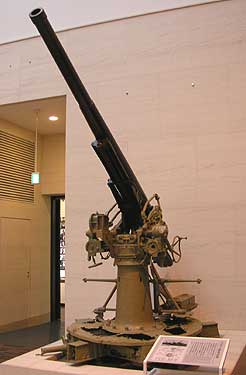
Sufferers in January 1971, and dedicated to Yasukuni Shrine by the association in August 1972.” Specs are given as follows.
Caliber 75 mm
Barrel length 321.2 cm
Muzzle velocity 720 m/s
Weight 2,450 kg
Maximum range 13,800 m
Maximum altitude 9,100 m
Incidentally, the B-29’s “service ceiling is 9,720 meters” (Wikipedia), but actual bombing runs, heavy with bombs, would have been lower, and as Japanese counterattack weakened they are said to have flown gradually lower.
The gun’s “maximum altitude 9,100 meters” would just about reach, and there were cases of shoot-downs. But does “maximum altitude” mean the height at which it still has real effect? Think of throwing a ball up: the highest point is where it has lost all momentum and starts to fall. I am not familiar with weapons specs, so I do not know what this “maximum altitude” means, but I cannot help thinking it was not effective against the B-29. And before that, anti-aircraft guns and shells must have been in absolute shortage.
In any case, these are precious war remains. I wished they would at least put up a sign.