

Slipping out of Palaceside Building again to Shimizu-mon. Stepping a little aside from the stone walls this time.
The photo above shows Shimizu-mon around the Meiji Restoration. A plate from the “Old Edo Castle Photograph Album” (from the National Museum website). The gate still stands, but “Shimizu-mon” also means the Shimizu house, one of the Tokugawa gosankyo. To confirm: the Tayasu, Hitotsubashi and Shimizu houses did not take their names from bridges where they already lived; they built residences at those bridges, and the houses took the names.
So what is the origin of the gate’s name? It is said that spring water welled nearby, or that an old temple, Kiyomizu-dera, stood in the area and the name was taken from it (perhaps the Seisuiji now in Asakusa. It is of course not Kyoto’s Kiyomizu-dera. I will look into this someday).
Let us review the place on Edo-period maps. I have written before about the Great Meireki Fire (1657, the “Furisode Fire”). In that fire, the largest of the Edo period, which burned about 60 percent of Edo’s urban area, the Honmaru of Edo Castle and the gosanke residences opposite the Nishinomaru also burned, and they moved to Akasaka and elsewhere. Including those sites, many residences around here relocated, leaving vacant land across the north and northwest of the castle. The aim, it is said, was to keep city fires from spreading into Edo Castle.
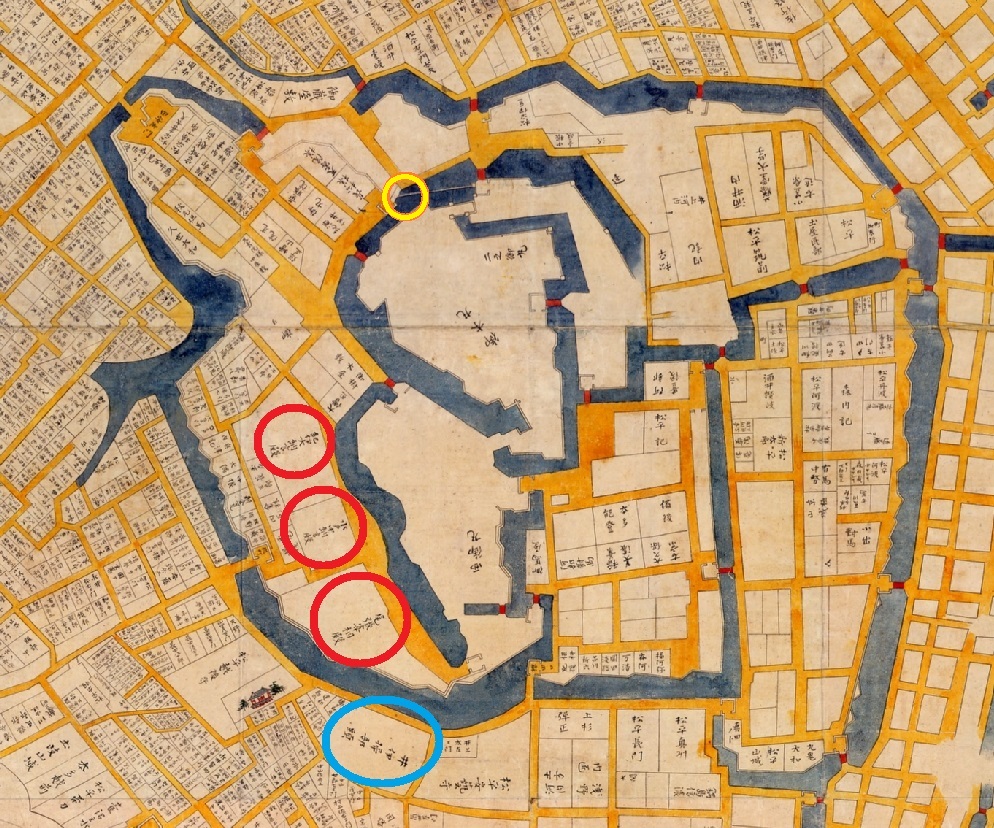
In time, some residences returned. So did those of the gosankyo. To confirm the gosankyo: the Tayasu house’s founder was Munetake, second son of the eighth shogun Yoshimune; Hitotsubashi was Munetada, Yoshimune’s fourth son; Shimizu was Shigeyoshi, second son of the ninth shogun Ieshige. They were granted residences inside their respective gates in 1730 (Kyoho 15), 1740 (Genbun 5) and 1758 (Horeki 8). They were not created all at once.
Compare the “Shoho-nenchu Edo ezu” from before the Great Meireki Fire (map above) with the “Tempo kaisei Go-Edo oezu” after the gosankyo residences were built (map below). The yellow circle is Takebashi; the blue circle is the Ii residence outside Sakurada-mon, which stood until the end of the shogunate. The red circles mark the gosanke and
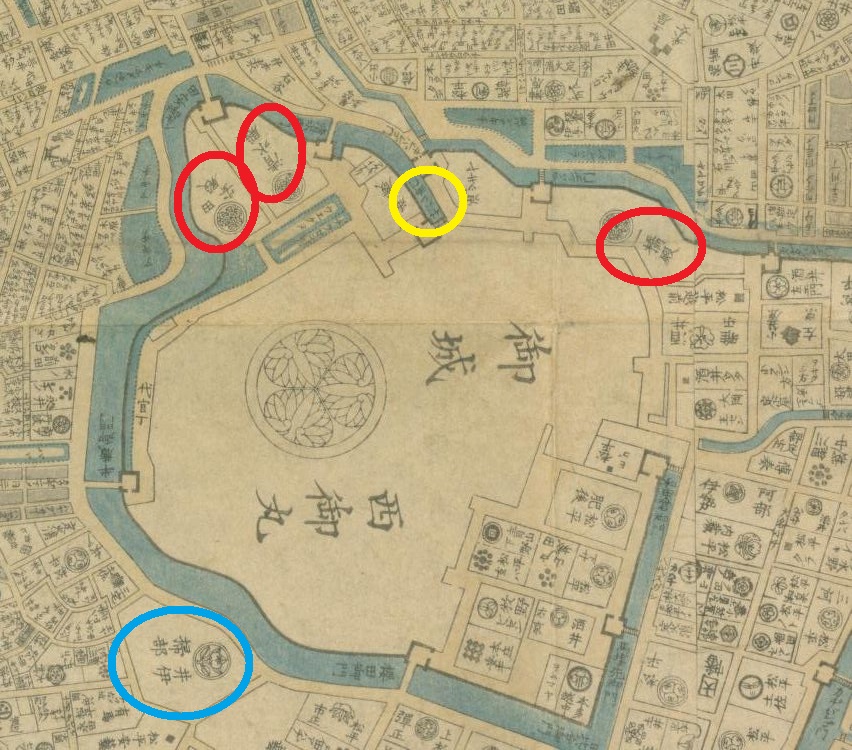
gosankyo residences.
Incidentally, the site of Palaceside Building is to the right of Takebashi on the map below, labeled “Otsukiya.” It was something like a shogunate food warehouse.
Perhaps, as memory of the great fire faded, residences were built even on land that had been meant as a firebreak.
Even so, fires broke out many times until the end of the shogunate. According to the Chiyoda Tourism Association website, a great fire in 1863 (Bunkyu 3) burned the Honmaru, and the 11th shogun Iemochi (1846–1866) and his wife Chikako (Seikan’in-no-miya) are said to have stayed temporarily with the Shimizu house. The Honmaru was never rebuilt after that.