

Stepping out of Palaceside Building to walk the stone walls of Edo Castle (the Imperial Palace). Last time I took up Hibiya-mon; having come this far, I looked a little into Hibiya Park. There is more we do not know than we think.
When Tokugawa Ieyasu entered Edo, this area was called Hibiya Inlet—in other words, the sea. Work such as digging Sakurada-bori from Hanzomon to Sakuradamon shaped the surroundings, and soil from the moats
filled the inlet; daimyo residences followed.
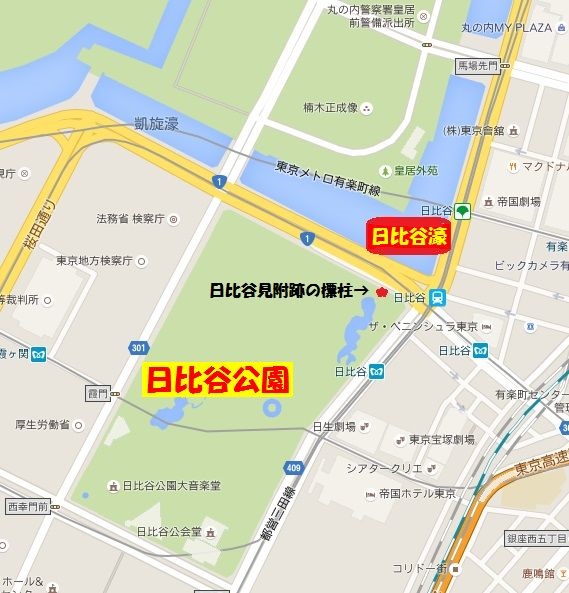
The moat across Uchibori-dori from Hibiya Park’s Yurakumon is Hibiya-bori. Among the moats around the palace it runs in an L from Iwata-bashi to Babasakimon, from Uchibori-dori toward Hibiya-dori—in front of the Imperial Theatre and the like. The moat is said to have been finished around 1608 (see map at left). Hibiya-bori is visible toward the upper right in the photo above.
The present park area held the Edo upper residences of great houses such as the Mori and Nabeshima. After the Meiji Restoration it became open ground called Hibiya-ga-hara, then an army drill field, which moved in 1888 (Meiji 21) to the former Aoyama powder-magazine site (today’s Meiji Jingu Gaien). The vacant land was slated for government offices in a concentration plan, but as former inlet the ground was poor and judged unfit for large buildings.
In November 1888 use as parkland was proposed, and the next year Tokyo City adopted a plan for parks No. 1 through No. 49, with Hibiya Park as the first. Earlier large city parks such as Ueno and Shiba had grown from temple and shrine grounds; building a park from bare land was a first. In 1893 Tokyo City bought Hibiya from the army and named it Hibiya Park.
The plan was not easily settled, and construction came much later. Several schemes had pluses and minuses; in 1901 Honda Seiroku, just back from Germany, finally led a decided plan. Work began in April 1902, and a provisional opening was reached on June 1 the next year. Honda’s scheme aimed at a German-style garden
yet kept Japanese elements such as the “Shinji-ike” pond that uses the moat introduced last time—that mix was likely what won praise.
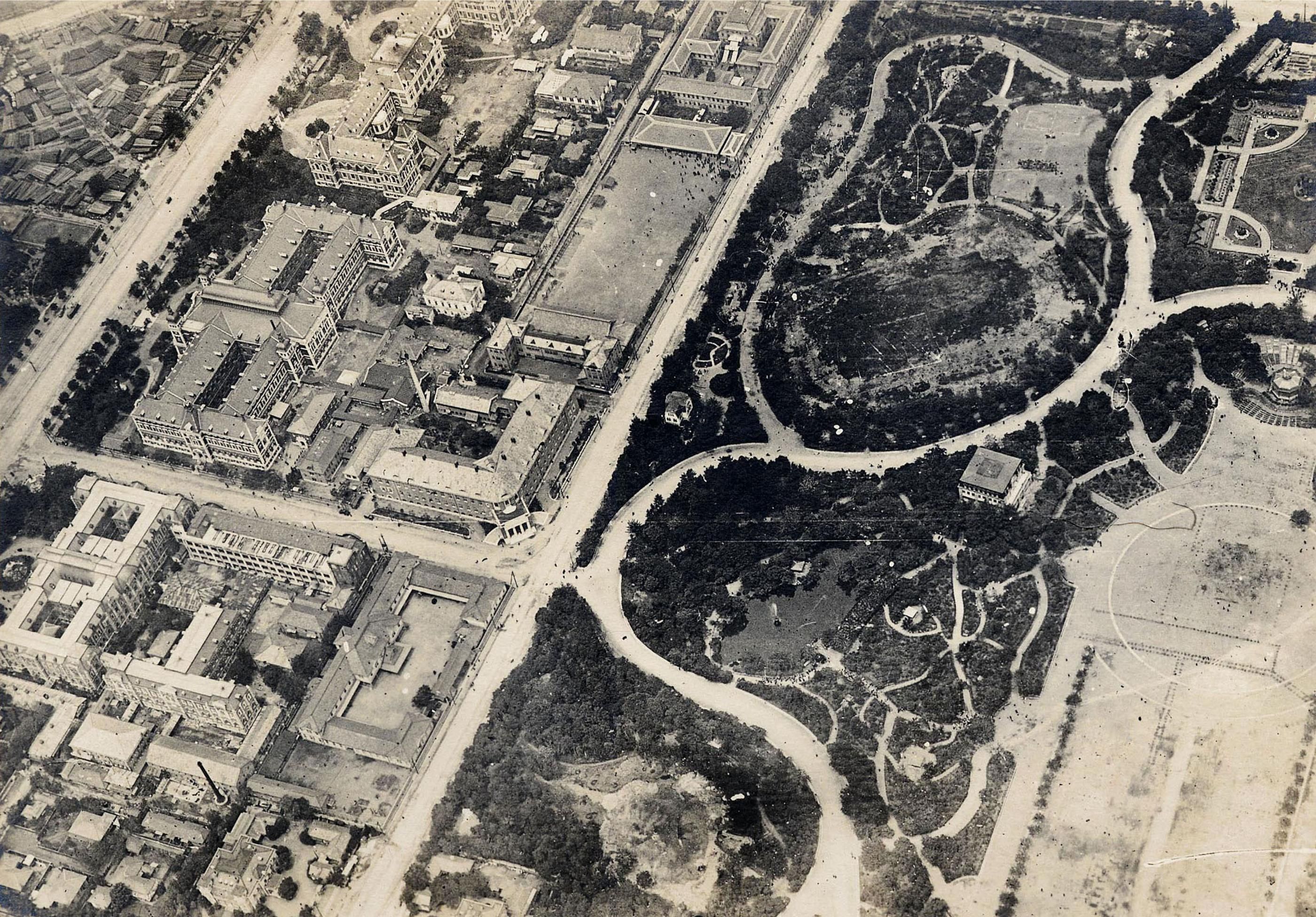
An aerial photograph from 1922 survives (photo at right). The vacant lot at upper left is now the Metropolitan Police Department. Across the road from that lot stood (from the top) the Ministry of Justice, the Great Court of Cassation and the Navy Ministry. Government buildings have since risen high, and the park’s trees have grown.
It is, literally, an oasis in the city center. There are tennis courts, which I sometimes use (I almost never win the lottery). Poor ground turned out to be a blessing.