
A Sumitomo Mitsui Banking Corporation ATM (automated teller) has been installed on the first floor east of Palaceside Building. It has been running since June 25, and people are already using it.
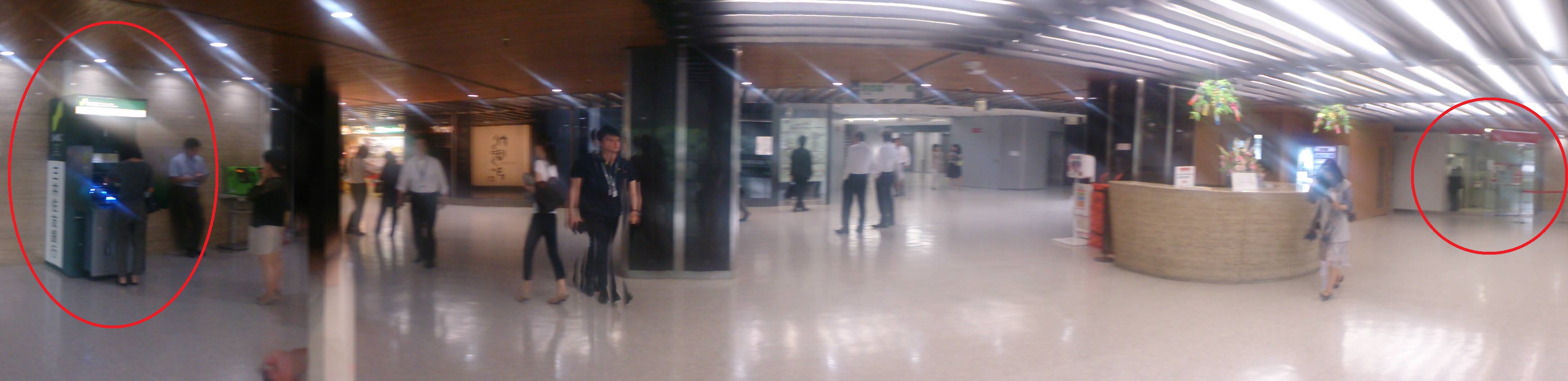
In more detail: as in the photo below, to the right after coming up the east main entrance on the first floor is a Bank of Tokyo-Mitsubishi UFJ ATM corner (two machines; red circle at right in the photo). Across the reception desk, beside Kappougi and in line with the public phones, the new machines were added (red circle at left).
Public ATMs in the building now number six: Japan Post, FamilyMart and Seven-Eleven convenience stores, Bank of Tokyo-Mitsubishi UFJ (two), and this one.
Hours are 7:00–24:00 for the new SMBC machines, 8:00–21:00 for Bank of Tokyo-Mitsubishi UFJ, 8:00–21:00 for the post office, and store hours for the two convenience shops (both 7:00–23:00). All ATMs are closed Sundays and holidays.
Japan is said to have well over 100,000 ATMs. The leader is Japan Post Bank (26,698 as of the end of March 2014), followed by Seven Bank in Seven-Eleven stores with 21,316 (end of May 2015). Megabanks have several thousand each, and JA Bank about 10,000.
Worldwide, China has the most at about 500,000, the United States second at just over 400,000. Searching the web, I found a site ranking ATMs per 100,000 people (http://top10.sakura.ne.jp/IBRD-FB-ATM-TOTL-P5.html). Using “2012 World Bank” data it lists (1) Canada 207.77, (2) Portugal 185.36, (3) Russia 182.00, (4) Macao 178.76, (5) Australia 165.95, (6) Spain 138.15, (7) Japan 127.78, (8) Albania 120.79, (9) Brazil 118.60, (10) Israel 116.40…. China is 37.51, 77th. Yonhap News of South Korea reported on November 15, 2014, that Korea, listed as “unknown” in that statistic, is in fact first—282 per 100,000, far ahead. Japan slips one place to eighth. The same ranking also drops the U.S., Britain and Germany; Britain, next after Japan, has about 124, ninth.
“Developing countries have fragile financial infrastructure, and ATM spread is uneven” (Yonhap), yet inside Japan sparsely populated areas sometimes have more machines per person—so the numbers may not mean much. Take it as trivia.