

A long-delayed sequel to two pieces last spring on Mito plums.
Did you know you can buy the fruit from Kairakuen in Mito (^ω^)? Ibaraki prefectural staff knock down the fruit every June (photo above). They gather a great deal=
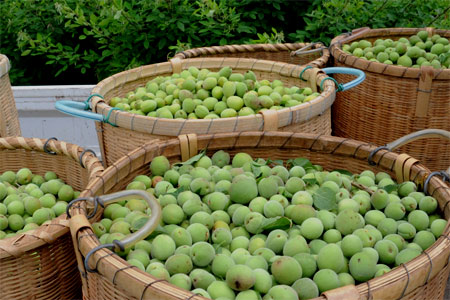
photo at left. The best are sold for two days only inside the park as “Kairakuen plums,” a yearly custom.
This year’s drop was June 12 (Fri)–14 (Sun) at Kairakuen and June 11 (Thu)–13 (Sat) at nearby Kodokan. Sales at Kairakuen were Saturday and Sunday the 13th and 14th, from 9:00 a.m. One bag (1.5 kg) is 300 yen (photos at left and below), 2,000 bags a day, 4,000 in all—a scarce item (last year was 3,000, so the crop looks better). To let as many people buy as possible, the limit is two bags
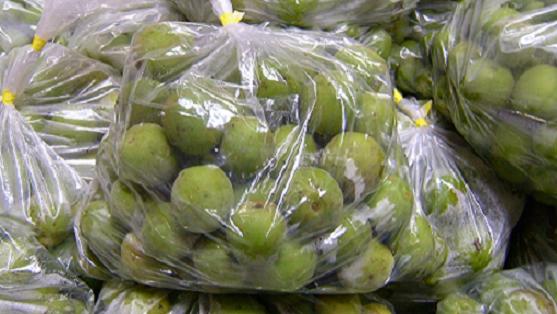
per person.
From the city center around Palaceside Building, Mito has become easier with Joban Line trains into Tokyo Station. On a weekend morning there are through trains such as Hitachi No. 1 leaving Tokyo at 6:53 (Mito 8:10) and Hitachi No. 7 at 9:53 (11:05).
As I wrote here before, the plum is “Ibaraki’s tree,” so in this farming prefecture the harvest should be large… or so one thinks. In fact it is not much. The Ministry of Agriculture, Forestry and Fisheries fruit survey released this May puts the 2013 harvest at 111,300 tons nationwide (shipments 97,000), of which Wakayama (the plum is the “prefectural flower”) has 71,400 tons—64 percent, far ahead. Second is Gunma at 5,400 tons, under a tenth of that, then Nara, Nagano, Mie, Yamanashi, Fukui, Kanagawa, Miyagi and Fukuoka. Ibaraki is 1,380 tons, 11th, not even in the top ten (shipments 13th).
Efforts to brand the fruit and recover the ground are sometimes covered in local papers and national prefectural pages. Let us hope those efforts bear fruit.