

I have been introducing the area around Naka-no-mon of Edo Castle (the Imperial Palace), across from Palaceside Building. On the way farther up to the Honmaru (the plaza before the keep foundation) there is another gate site. This is the remains of Chujaku-mon (photo above). I earlier called Naka-no-mon the “last barrier” to the Honmaru; strictly, this gate lay still farther in, so that was imprecise.
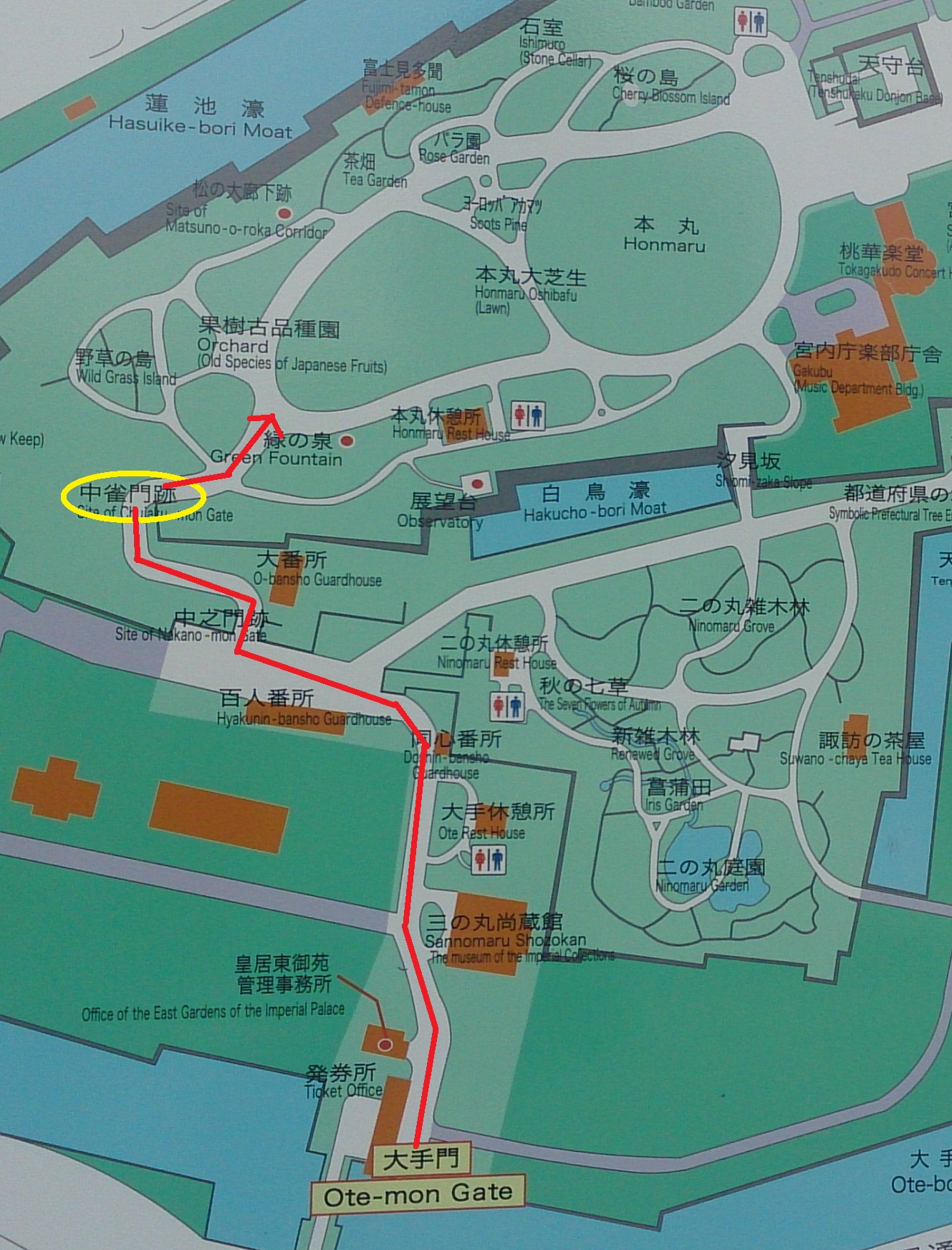
Enter Naka-no-mon, turn left before the Great Guardhouse, and climb a slope past walls of large stones. The slope sits on the old boundary between the low ground east of the castle and the plateau of the Honmaru; after the climb, a right turn brings you to Chujaku-mon, the Honmaru’s main gate. It is a slope now; in the Edo period it is said to have been steps. Beyond it a broad plaza opens—the site of the former Honmaru palace—and one feels again how the castle forbade a straight path for security (see map at left).
That the keep burned in the Great Meireki Fire of 1657 has often been written here. The keep-foundation walls were badly burned then and Izu stone was replaced with granite; reusable original stones were moved to walls such as this Chujaku-mon. (Badly damaged pieces were used as buried
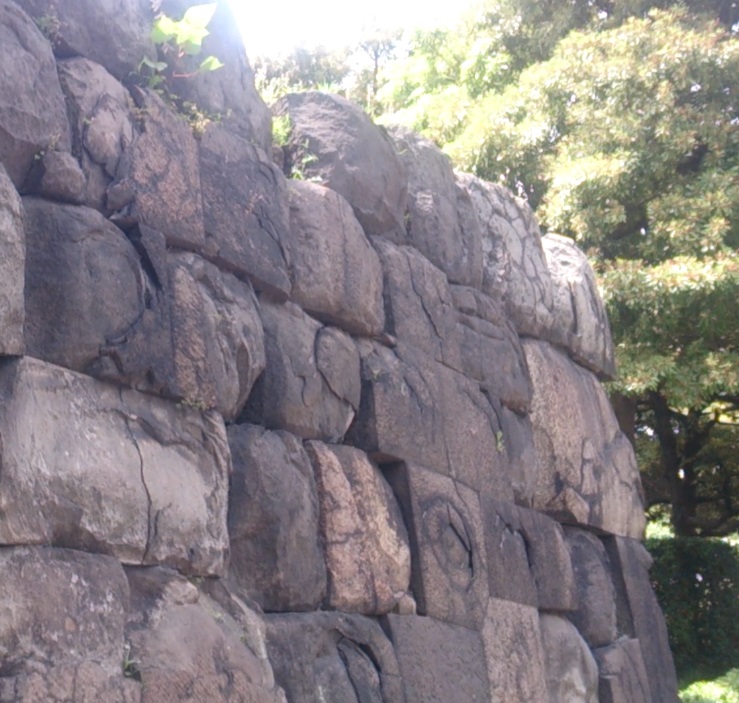
foundations and the like.)
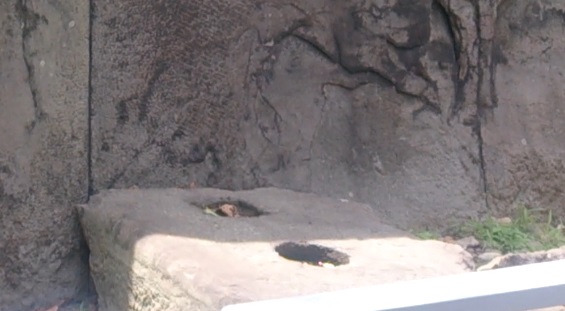
Fires, however, continued through the Edo period. When the Honmaru palace burned in 1863 (Bunkyu 3), late in the shogunate, Chujaku-mon caught as well and the wall faces crumbled from heat. That is what remains (photos at right and above). Below the walls, grooves for pillar foundation stones also remain (photos at right and below).
There are several theories of the name “Chujaku.” One derives it from “chujaku,” brass: costly brass was once used. Another traces it to Suzaku, the southern guardian of the Four Gods, because the gate lies south of the Honmaru.
Still another says it shifted from a “middle-fence” (chuzaku) gate built inside the castle. In any case, as the gate nearest the Honmaru it was likely richly decorated with brass and the like.
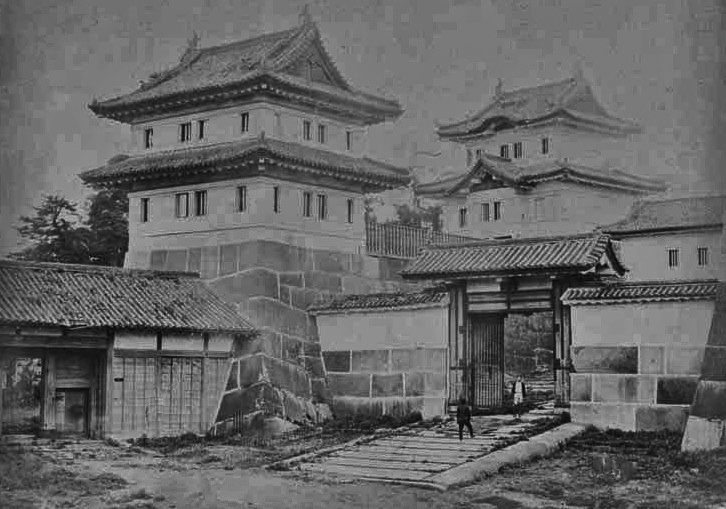
A photograph thought to be from the late shogunate or early Meiji (photo at left) shows two two-story turrets on the left. The nearer turret, two stories of equal size, was also called the “jubako turret.”
Security must have been tight. Ten yoriki and twenty doshin were posted; even the Tokugawa gosanke alighted from their palanquins before this gate and walked on to the Honmaru.