
Walking Edo Castle (the Imperial Palace) across from Palaceside Building, I recently introduced the Hyakunin-bansho just before Naka-no-mon. Guard posts—or checkpoints—“bansho” stood throughout the castle; only three remain, all around Naka-no-mon, including the Hyakunin-bansho.
Heading from Ote-mon toward the Honmaru, past the Ote rest house and just before the road turns left at a right angle toward Naka-no-mon, the Doshin-bansho appears on the right; after that left turn the Hyakunin-bansho is on the left; and just after passing Naka-no-mon opposite it and starting up the slope toward the Honmaru, the Great Guardhouse is immediately on the right (photo above). Their positions,
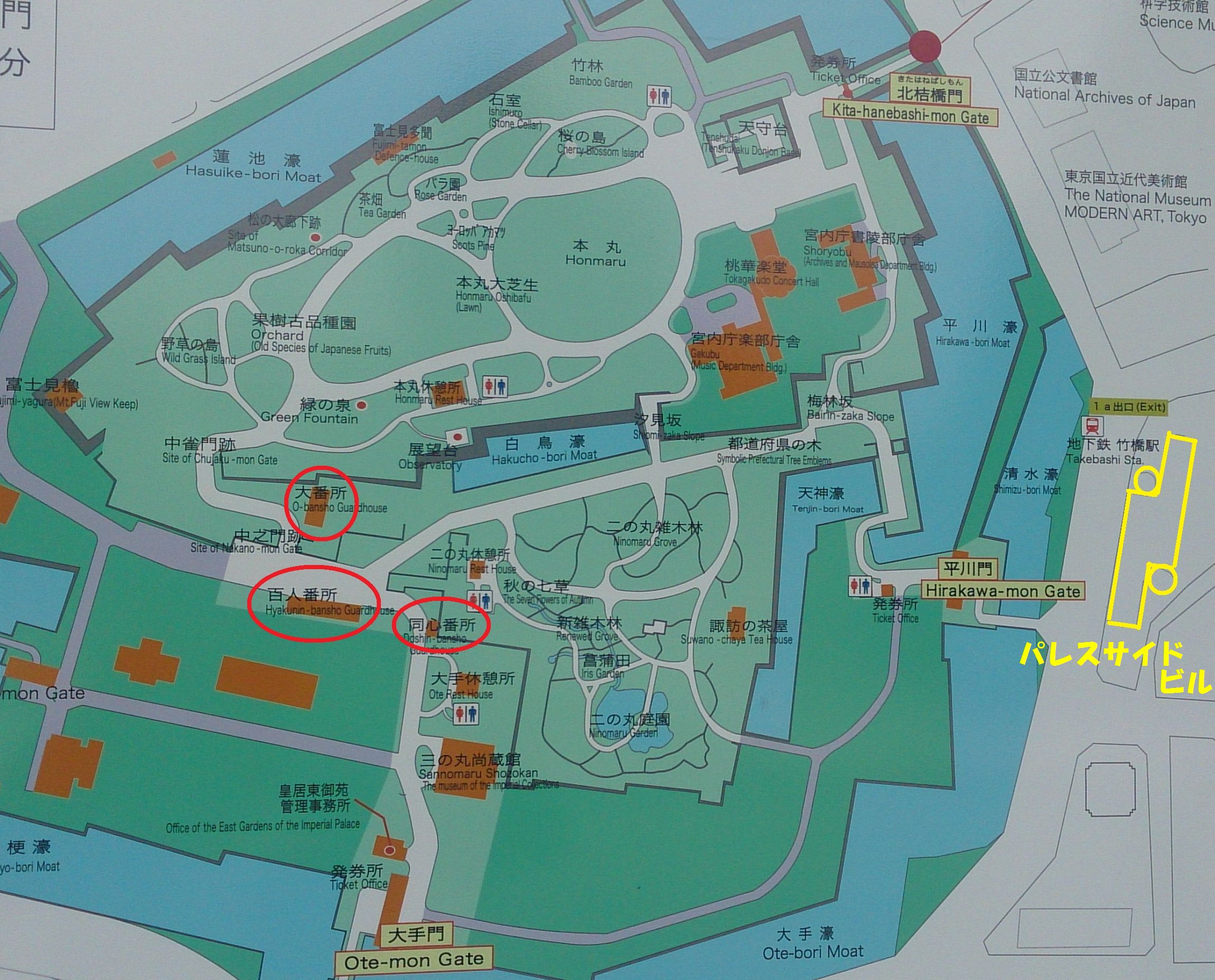
confirmed, look like the map at left.
I explained the Hyakunin-bansho last time. Of the other two, the Great Guardhouse was the last post before the Honmaru. Its security role must have been vital; the notice board says it was “guarded by yoriki and doshin of higher rank than at other posts.”
The Chiyoda Tourist Association website writes: “The Great Guardhouse is a reconstruction, but it is a fine building of old character, and the fifteen firing steps behind it are old as well.”
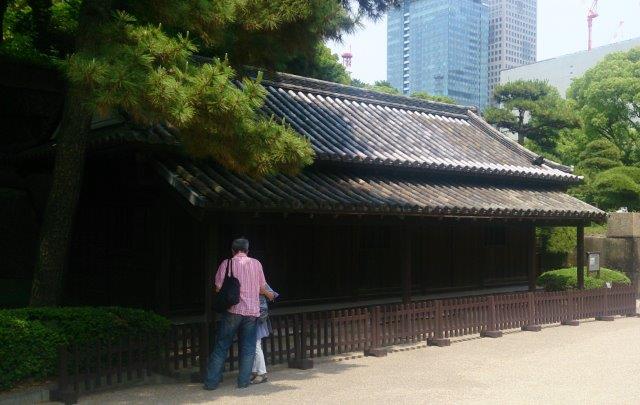
(http://www.kanko-chiyoda.jp/tabid/251/Default.aspx).
The Doshin-bansho (photos at right and above) was the first post daimyo passed after entering at Ote-mon, just inside the former Ote San-no-mon. The San-no-mon walls still remain (photos at right and below). Behind them to the right is the Doshin-bansho. According to the association site, San-no-mon was “originally a masugata gate, with both sides
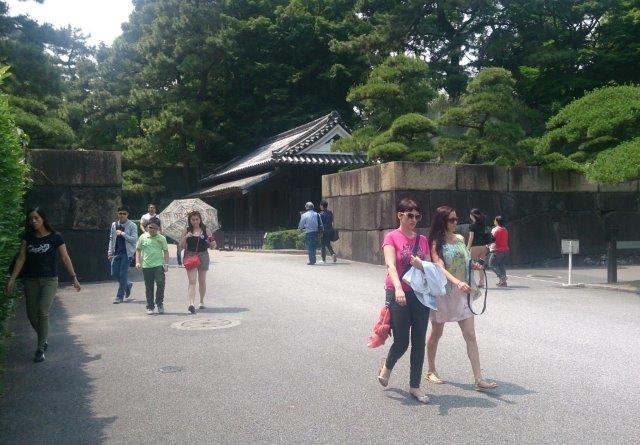
and a water moat” (http://www.kanko-chiyoda.jp/tabid/989/Default.aspx).
Among the three posts the Doshin-bansho ranked lowest; its task seems to have been watching attendants more than the daimyo themselves. Only the lords of the Tokugawa gosanke—Owari, Kii and Mito—could pass still in their palanquins; all other daimyo were made to alight, so San-no-mon was also called the “dismounting gate.” Attendants waited here for their masters’ return and exchanged news. That is said to be the origin of “gebahyo”—hearsay at the hitching post.
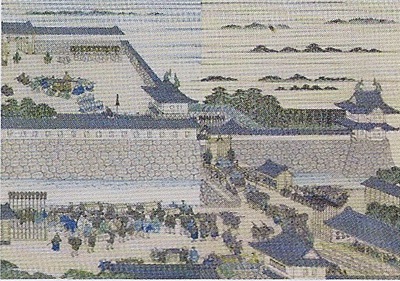
The picture at left shows daimyo arriving at the castle (from the “Tokugawa Seiseiroku,” National Diet Library). At the foot of the bridge, slightly right of center, is the Doshin-bansho.
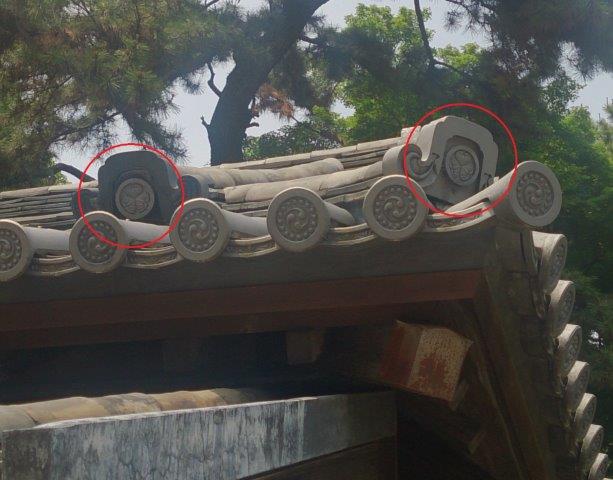
On the Doshin-bansho roof, only the highest tiles bear the Tokugawa hollyhock crest (photos at right and below); the red circle marks the crest. If you visit, look closely.
A brief note on the yoriki posted at each station and the doshin under them. Yoriki originally meant “one who gives aid” in the Kamakura period, then came to mean lower samurai serving a powerful warrior; doshin were samurai
still below them.
Period dramas give a strong image of catching villains at a magistrate’s office—those are town yoriki and town doshin. The term also covered lower officials under shoshidai, castle deputies, oban-gashira and others, doing clerical and guard work.