

Out of Palaceside Building for a walk at Edo Castle (the Imperial Palace). I have been covering Naka-no-mon in detail. After all, stones of as much as 35 tons—among the largest in the castle—are used, and their faces are finely dressed. The core, as one would expect.
Just before Naka-no-mon stands a large—or rather, very long—building: the Hyakunin-bansho.
A “bansho” is a guard post. A checkpoint may be the better word.
The building, over 50 meters long, was the largest of the castle’s many posts. Four teppo-hyakunin
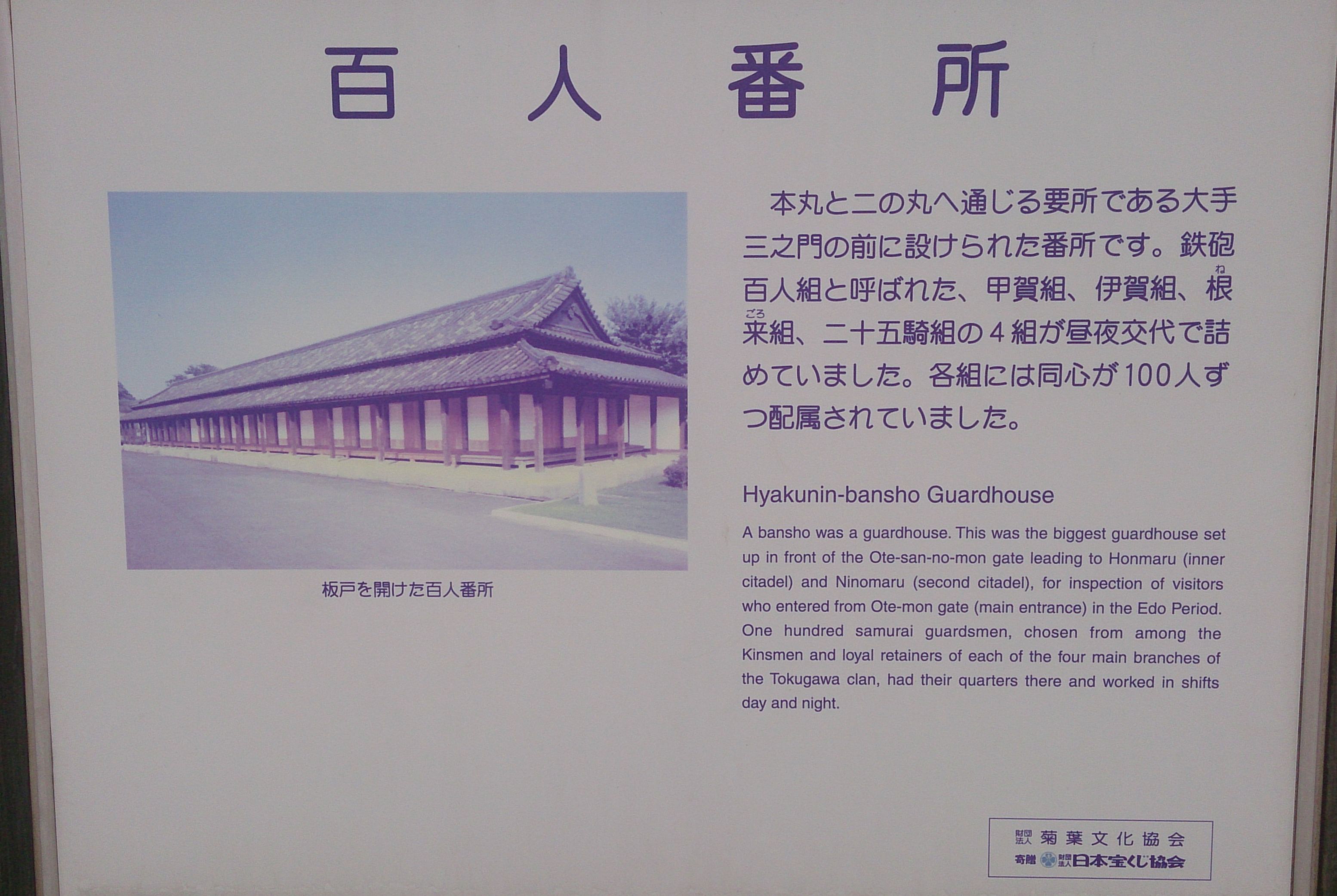
units—Koka, Iga, Negoro and Nijugoki—took turns on watch day and night, as the notice board also says (photo at right). Each unit was assigned 100 doshin, hence the name “hundred-man post.”
The four names bring ninja to mind. The Koka unit was a band from southeastern Shiga (Koka City); the Iga unit, from Iga-Ueno (Ueno, Mie), was led by the famous Hattori Hanzo. Tokugawa Ieyasu hired them to probe other daimyo and keep order in Edo. The Negoro unit grew from a gun corps centered on warrior-monks of Negoro-ji in Kishu Negoro (Naka District, Wakayama); after losing to Hideyoshi they were taken on by Ieyasu. The Nijugoki unit began as an elite band Kuroda Kanbe chose from his retainers—Goto Matabei and Mori Tahei among them. It is often called the “Kuroda Twenty-Four,” but with Kanbe’s heir Nagamasa it was also the “Twenty-Five.” Nagamasa, trusted by Ieyasu, inherited the line and was picked to guard Edo Castle.
The four units were formed as independent troops under the wakadoshiyori (the post next to the roju), reporting directly to the bakufu. When the shogun worshipped at Kan’ei-ji or Zojo-ji they guarded the temple gates—a kind of imperial guard.
Barracks stood at Aoyama (Koka), Okubo (Iga), Ichigaya (Negoro) and Naito-Shinjuku (Nijugoki)—all along the Koshu Kaido. If the castle were ever taken, the shogun was to slip out Hanzomon, opposite Ote-mon, and flee via Naito-Shinjuku along the Koshu Kaido through Hachioji to Kofu, bakufu land—hence the placement of the houses.
Near Okubo there is a place-name “Hyakunin-cho, Shinjuku-ku,” from the Iga barracks. The name of Kaichu Inari Shrine in front of Shin-Okubo Station, the shrine’s website says (http://kaichuinari-jinja.or.jp/), comes from the Iga gunners’ “everyone hits the mark.”