
I wrote four times in January and February about Naka-no-mon of Edo Castle (the Imperial Palace), across from Palaceside Building. Here is a related topic after a pause.
I have said more than once that the Ikeda house of Ikeda Yoshitasu, third lord of the 320,000-koku Tottori domain who repaired the gate in 1704, was a distinguished line given standing next to the Tokugawa kin (shinpan).
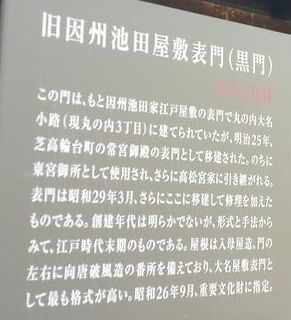
Through three centuries of Tokugawa rule, a daimyo’s Edo residence reflected rank and wealth. Many know the fine gate visible from the road at the Tokyo National Museum in Ueno Park, classed as an “outdoor exhibit” (photo above). The notice board reads “Former Inshu Ikeda residence main gate (Kuromon)” (photo at right). Yes—it was the main gate of the Tottori domain’s Edo upper residence. It stood in the Edo period on former Marunouchi Daimyo-koji (today’s Marunouchi 3-chome, Chiyoda-ku), was moved in the Meiji era as the main gate of the then Crown Prince’s Palace, passed to the Takamatsu-no-miya residence, and in 1954 (Showa 29) was rebuilt in Ue
no. It is a National Important Cultural Property.
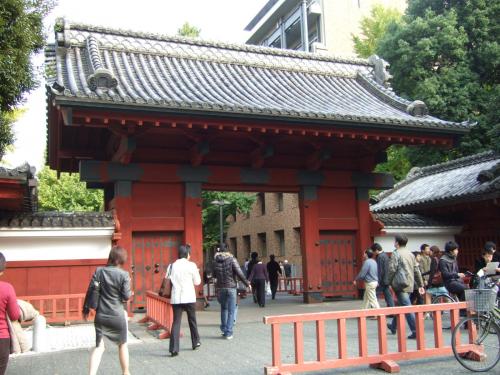
Speaking of gate color, there is a famous one: the University of Tokyo’s “Akamon” (photo at left). The Hongo campus once held the Kaga domain Maeda family’s Edo upper residence; the red gate was built in 1827 when the twelfth lord Nariyasu received Yohime, twenty-first daughter of the eleventh shogun Tokugawa Ienari. When a wife came from the shogun’s house, custom was to paint the gate vermilion; this Akamon is the only one that survives.
The Ueno gate, as it looks, is also called “Kuromon,” but the name has not stuck as Tokyo’s Akamon has. Wondering why, I learned Ueno had another “Kuromon.” That must be the source of the confusion.
On May 15, 1868, the Shogitai and others unhappy with the bloodless surrender of Edo Castle barricaded themselves on Ueno Hill and resisted the new government; government forces crushed them in the Battle of Ueno. One of the fiercest points was the foremost of eight gates on the hill, called the “Kuromon.” The bodies of 266 Shogi
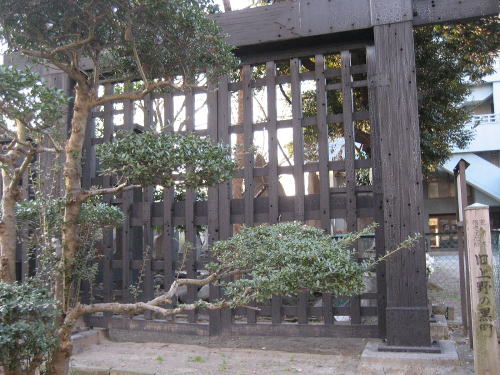
tai dead were long left uncollected for fear of the new government; the priest of Entsu-ji (1-chome Minami-Senju, Arakawa-ku) and others recovered them, buried them at the temple and built graves. The temple website says the gate was granted by the Imperial Household Museum (forerunner of the Tokyo National Museum and others) in 1907 and moved onto the grounds. It remains an Arakawa Ward designated tangible cultural property; can you see the columns riddled with holes (photo at right)? Bullet marks from the Battle of Ueno.
Historical relics do not all tell cheerful, bright stories.