

It is an exhibition well worth seeing. I went to “Botticelli and the Renaissance: Wealth and Beauty in Florence” (organized by The Mainichi Newspapers and others). The venue is Bunkamura The Museum in Shibuya, Tokyo. Over the holiday it was less crowded than I expected. It runs through Sunday, June 28.
Many works by Sandro Botticelli (1445–1510)—known for the Annunciation, Madonnas, Venus and more—and his workshop have gathered from Italy, France and the United States. Seventeen works, including fourteen never shown in Japan, can be seen at once: a unique chance.
The highlight is still the Uffizi treasure, the fresco (mural) Annunciation (photo below). The large work, 2.43 meters tall and 5.55 meters wide, looked on close view as if cut in two down the middle. Even in two pieces, how hard it must have been to
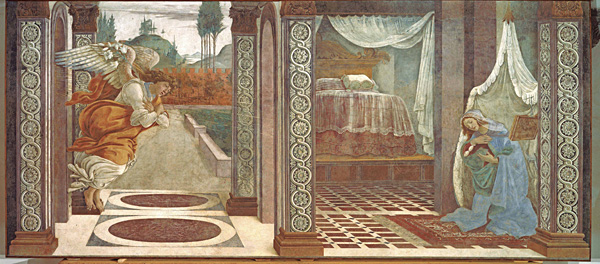
move. It was on a wall of the chapel at the Santa Maria della Scala hospital in Florence and was detached in the early twentieth century for the Uffizi,
they say. It shows the moment the archangel Gabriel, sent by God, tells Mary, “You will conceive and bear a son, and you shall name him Jesus.” Lighting in the gallery was kept low, perhaps to spare the painting; it looked a little duller than photographs, but a solemn aura filled the space. Including the fresco’s surface relief, one felt the artist’s breath.
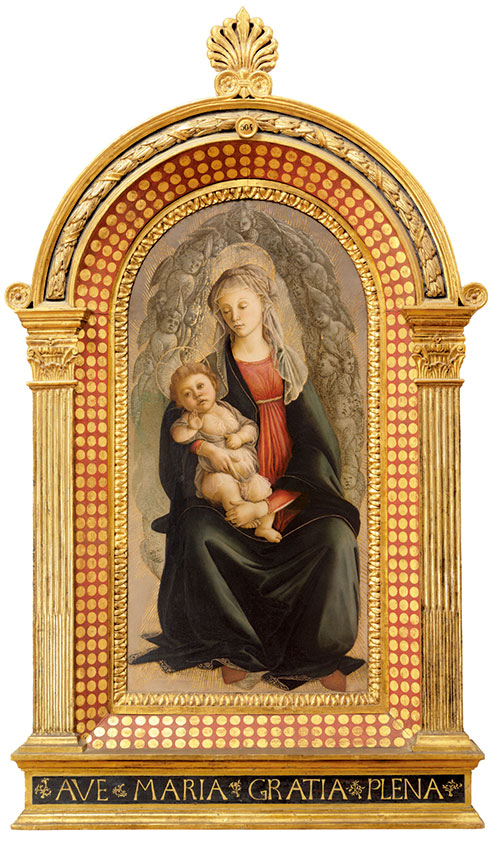
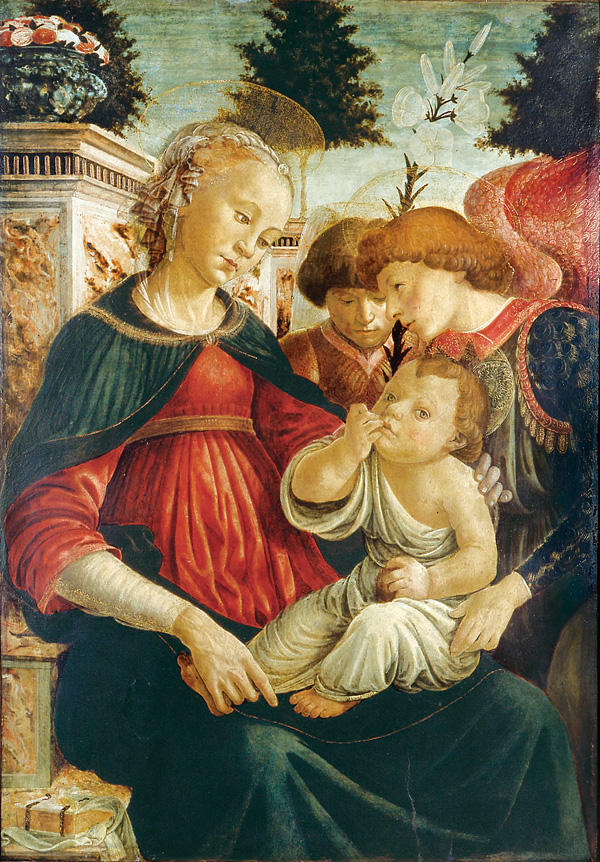
From Madonna and Child with Cherubim (c. 1470, tempera on panel, 120 × 66 cm, Uffizi) (photos at right and above) to Madonna and Child with Two Angels, a tempera of c. 1468–69 (Musée des Beaux-Arts de Strasbourg) (photos at right and below) and a same-titled work from the National Gallery of Art in Washington, the rooms were full of mother and child. The face of Jesus and Mary’s expression differed greatly by work.
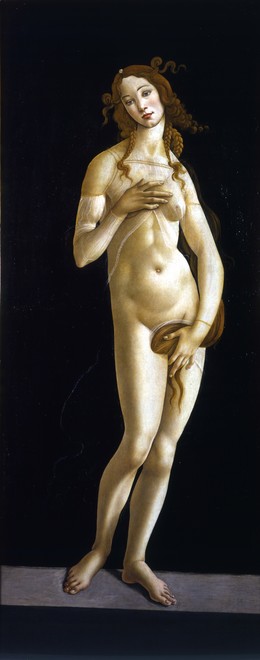
There is also a Venus that isolates the goddess from Botticelli’s Birth of Venus=
photos at left and below. Painted against black that sets off the beauty of the contour, three workshop versions are known; this is one. It is quite seductive, though I seem to recall a note that Botticelli was in fact uneasy with women.
The masterpiece Madonna and Child with Saint John the Baptist (c. 1477–80, tempera on panel, diameter 96.5 cm, Musei Civici di Piacenza), on Italy’s “do-not-export” list, was also shown—but only through May 6. For other works see the official site (http://botticelli2015.jp).
This time Botticelli’s works were of course the draw, but the rich account of Renaissance history was a harvest beyond expectation.
That artists in fifteenth-century Florence, the city of flowers, produced so many masterpieces required the financial power of the Medici, who were also bankers. They had grown rich dominating trade and business across Europe and through finance. Islamic finance, which forbids interest, is much discussed of late; the Bible itself is said to forbid lending to one’s brethren for profit. Yet as a money economy grew, moneylending became necessary in daily life and was allowed to Jews, who were not Christian “brethren”—The Merchant of Venice. Fee businesses such as money-changing gradually spread. Medici “banking,” it seems, built credit by issuing gold coin against wealth, then developed in the form of bills on that credit.
Did merchants such as the Medici, who regularly donated to churches, commissioned religious paintings and nurtured artists as patrons—akin to today’s mécénat—do so in a spirit of “atonement” for taking “profit” in trade?
Around the Medici decline, a conservative faction opposed to the pope rose for a time under the friar Girolamo Savonarola
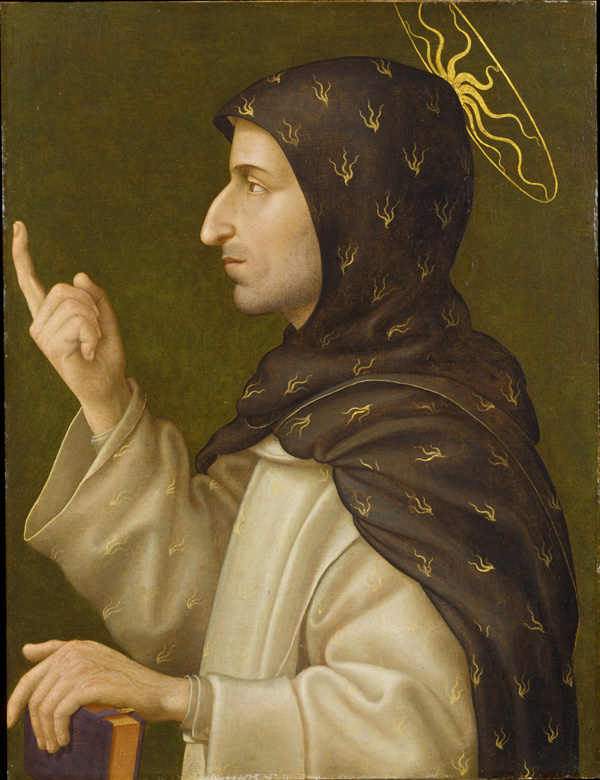
(photo at right); as part of a crackdown on luxury he called for a “bonfire of the vanities,” and many works of art were reduced to ash. Botticelli did not burn his own paintings, but under Savonarola’s influence his style grew dark. Those works are a little hard to look at. Savonarola, in the end, was burned by the people.
Same-day tickets are 1,500 yen general, 1,000 for university and high-school students, 700 for junior-high and elementary pupils. Hours are 10:00–19:00, until 21:00 Fridays and Saturdays (last entry 30 minutes before close). Open every day through the end of the run.