

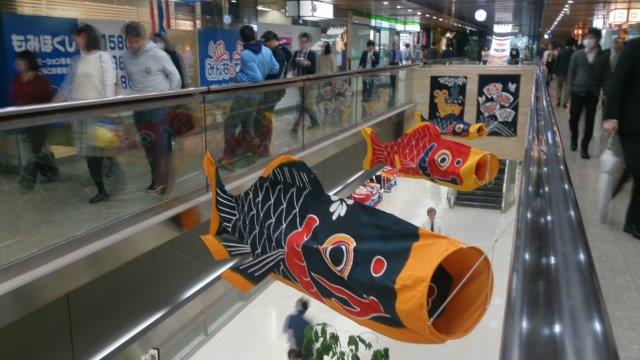
At Palaceside Building, carp streamers and warrior banners in the atrium of the first-basement and first-floor arcade central corridor are delighting passersby (photos at left and below).
Come to think of it, when did the custom of carp streamers begin?
So I looked a little into their origin. As a custom in Japan they seem to have
appeared in the Edo period. What began as a samurai observance spread in the late Edo period to townspeople who had gained economic strength. The picture above is a black carp from “Suidobashi Surugadai,” No. 48 in Hiroshige’s (1797–1858) “One Hundred Famous Views of Edo.” The figure swimming as if looking up at Mount Fuji is splendid. Two more are visible in the distance.
As in this print, at first there were only black carp. From the Meiji era onward red carp were also hung, and the addition of child carp came much later. The children’s song “Koinobori,” known for “carp streamers higher than the roof,” has the line “the little red carp are the children.” The song first appeared in 1931 (Showa 6), so at least in the early Showa years there was no blue child carp, and the red carp was a child, not mother; “black and red = husband and wife” was not the reading. Even for Boys’ Day, it may reflect male precedence.
As time moved on, perhaps after the war the image of the carp streamer as a “family” took hold. The truth is unclear. I have not seen the original—only a web note—but the 1982 Ongaku-no-Tomo textbook “Elementary School Music 1” is said to have printed, in parentheses as a second verse, “…the big red carp is mother / the little black carp are the children…”
Palaceside Building’s Carp Streamer Festival is scheduled through Saturday, May 9. On Thursday, April 30 and Friday, May 1,
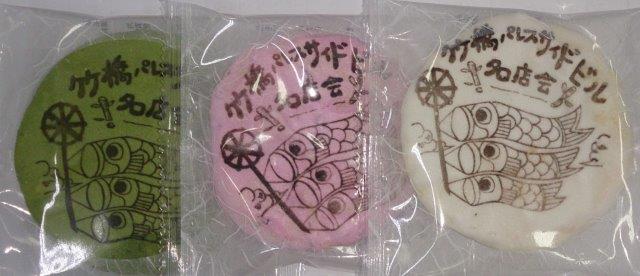
the first 4,000 people who use Meitencai shops on the first basement and first floor will receive original Meitencai rice crackers (photo at right).