

The 7th Carp Streamer Festival is under way at Palaceside Building. In the atrium of the first-basement and first-floor arcade central corridor, two warrior banners have appeared with the carp streamers. At 75 centimeters wide and 7.2 meters long they have real presence, one above each of the east and west Dream Stairs, hanging as if to cover people going up and down.
Like the carp streamers, the banners were resist-dyed by Watanabe Shokichi of Watanabe Dye Works, a Gujo Hachiman indigo house designated an intangible cultural property of Gifu Prefecture, in the Gujo honzome technique handed down for more than 400 years—as I wrote here on the 17th. Today, the pictures on the banners.
The east banner (photo above) is easy enough. Yes: Uesugi Kenshin in a white hood (upper part of the photo) and Takeda Shingen in a helmet (lower). It is the famous moment at Kawanakajima when Ken
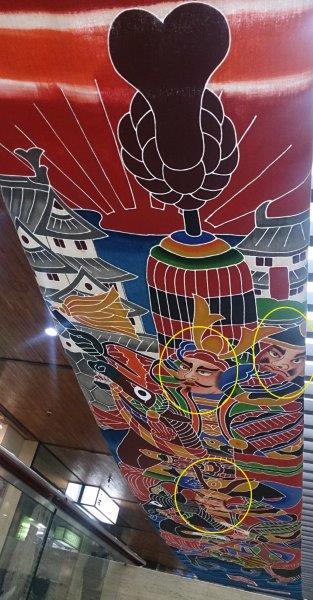
shin cut into Shingen’s headquarters. It is a popular banner for wishing a dignified life and offering congratulations.
What scene is the west banner (photo at left)? Watanabe Dye Works’ website had it: Toyotomi Hideyoshi flooding Takamatsu Castle in Bitchu during his campaign against the Mori. Indeed, the castle is ringed in blue water. The standard looks like the thousand-gourd uma-jirushi. Of the three figures, the center is Hideyoshi, Kato Kiyomasa below, and behind Hideyoshi like a guardian spirit, Fukushima Masanori. Mid-siege came the Honno-ji Incident and Hideyoshi’s “great return from Chugoku,” a highlight of last year’s NHK taiga drama “Gunshi Kanbei.” This too is a standard auspicious design said to invite advancement.
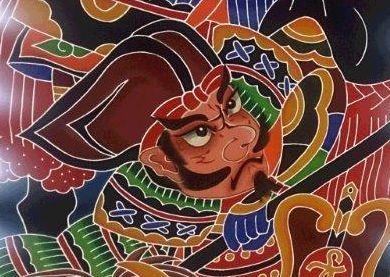
The Kawanakajima battle has one more figure. The photos at right and below enlarge the person in the middle of the top Kawanakajima picture. The dye-works site did not mention him, so I will guess. Facing right like Shingen, confronting left-facing Kenshin, gripping a long black pole (likely a spear shaft), and without a helmet, he is probably Hara Osumi-no-kami Torayoshi, a retainer of Shingen.
A recap: the Battles of Kawanakajima is the name for five clashes between the two over more than twelve years;
actual fighting at Kawanakajima occurred only in the second Sai-gawa battle and the fourth Hachimanbara battle. The fiercest was the fourth, in 1561 (Eiroku 4); “the Battle of Kawanakajima” usually means this, and the Kenshin–Shingen “single combat” was then.
Uesugi losses were over 3,400 dead and 6,000 wounded; Takeda over 4,600 dead and 13,000 wounded—more than 27,000 of 32,000 on both sides, 83 percent, among the Sengoku period’s fiercest fights. Shingen’s brother Nobushige and the famed strategist Yamamoto Kansuke also fell.
Whether there was a “single combat” is debated; tradition runs thus. Kenshin rode alone into Shingen’s headquarters, sword raised, and struck from the saddle; Shingen caught the blow with his war fan but was wounded in the arm. Then Hara Osumi-no-kami, Shingen’s “chugen-gashira,” thrust Shingen’s spear. He missed, but struck Kenshin’s horse at the knee; the horse reared and bolted, and Shingen escaped by a hair—so the story. It matches the banner’s picture.
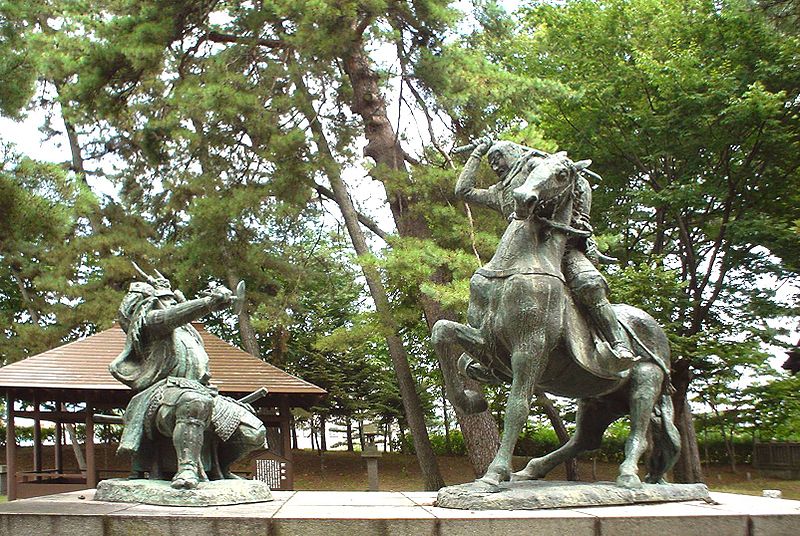
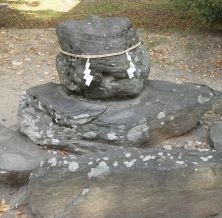
The site said to have been Shingen’s headquarters is today’s Hachimanbara Historic Park (Kojimada-machi, Nagano). The bronze statues there show the two heroes one-on-one (photos at left and above) with no Hara, but in the same park is the “Stone of Tenacity.” Tradition says that having saved his lord yet failed to kill Kenshin, he in chagrin drove his spear through a nearby stone; there is indeed a hole that looks as if a spear went through… (photos at left and below).
Incidentally, in the Edo period “chugen” were non-samurai who wore one short sword, sometimes joined
battle, did chores in peacetime, and in daimyo processions served as yakko (walking at the head with spears or hasami-bako). Originally the word meant those between combat ashigaru (of samurai status) and menials who did housework. Each daimyo and each vassal had “chugen” who in war stayed by their master, passed weapons and tended horses, so they were in effect combatants. Still more, the “head” of Shingen’s own chugen may have held a certain standing. He even bears the fine name “Osumi-no-kami”…
After this battle Osumi-no-kami’s merit was recognized and he is said to have received a 300-kan fief around Aimura (Shino-noi Ai, Nagano); there is a historic site said to be his grave. At least after this fight he was a formal samurai. After the Takeda house fell he served Tokugawa Ieyasu.